
I should probably start by noting that I don’t believe in writer’s block. I absolutely believe that there may be reasons that a writer doesn’t write, and some of them may be quite valid (as opposed to, say, making up crap to cover the fact that they’re just lazy). After a devastating experience in a writers workshop during my junior year in college, I didn’t write fiction for twenty-five years, apart from a couple of tiny efforts that I quickly abandoned. In my case, it wasn’t a block–it was pure fear, and I knew it. The fear didn’t begin to melt until someone whose writing I admired offered genuine and enthusiastic praise for a story I’d written. Turned out that just as some arrogant, ignorant students could shut me down with their withering comments, someone I respected could lead me back out into the sunshine.
This is not to say that I have a constant flow of confidence and I always find writing easy. I can still get jammed up, unable to come up with anything worth the effort of tapping keys. Like most writers, I have a hard drive full of false starts and outtakes, pieces that seemed to have promise until I grabbed them out of the air, crushed them in my hand, and smashed them onto the page. I expect that many writers have had similar experiences. A story is never so beautiful or perfect as the moment before we begin to put words to it.
Some people say that if you’re stuck—the words won’t come, the idea bank is empty, echoes reverberate in your brain—the answer is to fight through it. Butt in chair, hands on keyboard, and don’t get up until you’ve written. The fact that what you write may be utter dreck is beside the point. Especially if you’re a professional, waiting for inspiration is a luxury. Write the damned story, even if it sucks. You can’t edit a blank page.
In my opinion, while there’s sometimes merit to this approach, I find it behooves me to take advantage of time off. If I have a deadline or a commitment, I’ll press on, but if not, I step away and catch my breath, allowing my writing brain a bit of vacation time. I read other people’s good words, and if I’m lucky, I lose myself in their story rather than automatically analyzing what they’ve done and how effectively they’ve done it (a/k/a the writer’s curse).
Another tactic that I’ve found useful is to change the way I write. I mean, physically change it. If writing on the computer isn’t bearing fruit, I’ll pick up a pen and a notebook and let myself sketch the words—literally, with the pen strokes being part of the creative process. Whether I’m jotting notes for the story in progress or rambling about something else entirely, I find that the act of writing by hand can loosen the stuck joint. (By the way, this isn’t just my weird little quirk; there’s actual science to support the fact that handwriting can have advantages over typing for activities like learning.)
Maybe this is why the whiteboard worked so well for me. As you might recall, around this time last year, I was horribly stuck on Becoming Mrs. Claus. I was so stuck that if you’d asked me then, I’d have told you the book wouldn’t be out in 2023, and it might never see the light of day. I was terrified, because at that time, it really was that bad.
Then, on a Friday afternoon, someone on my Buy Nothing group gifted me a whiteboard. I dropped everything to run out and get it, took a detour to the office supply store to get an easel, and came home to set it up in my already-cluttered office. I took up the blue dry-erase marker, and at the upper left corner of the whiteboard, I wrote, “Meg”—and it all flowed. I listed Meg’s traits, her worries, her concerns. Then I picked up the pink marker, wrote “Isabella,” and did the same. I saw connections between the characters that I’d never seen. I made column after column, writing about the Clauses, Ralph and Meg’s relationship, and the plot that hadn’t gelled before that moment. For days afterward, every time I walked into my office, I added notes to the whiteboard. I was unstuck, and it was glorious—and as you know, the book did indeed get finished and published.

Since Becoming Mrs. Claus came out, I haven’t written much that wasn’t billable work. Part of it was the exhaustion of the holiday market season, and part was dealing with my mother’s mini-stroke in mid-January. Around Christmas, I spent a couple days hand-writing a possible family saga, but then I put it down. I made a few notes about a possible third Claus book, and my brain is playing with those ideas and whether they’re enough to sustain an entire novel, but I haven’t started writing because that would be a commitment and somehow, I’m not quite ready to commit to a story line.
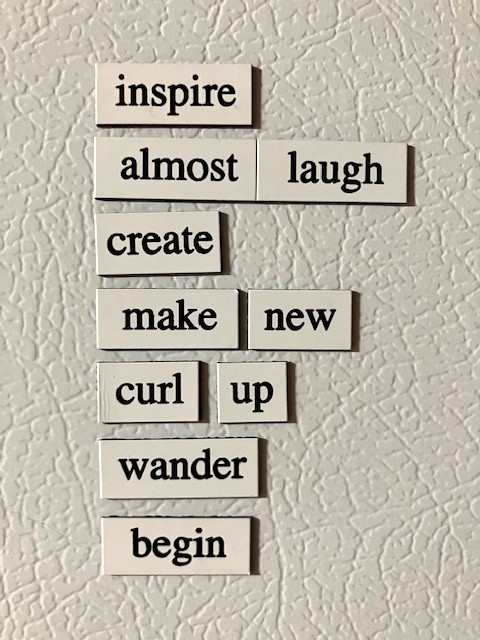
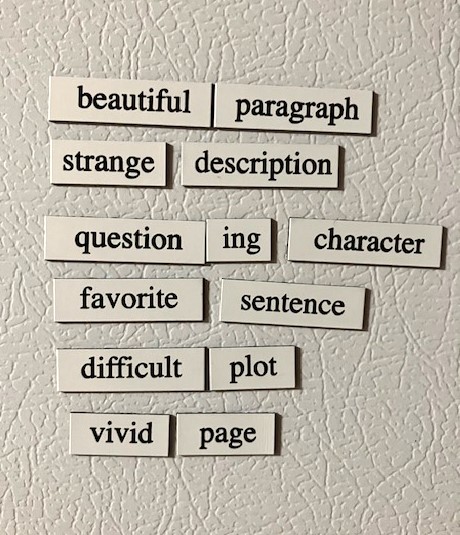
In my non-writing state, I’ve been tackling cleaning jobs around the house that have desperately needed attention. One thing I did was to clean the entire kitchen, including taking all the magnets and photos and sayings off the refrigerator. I put everything on a tray with the intention of sorting through and deciding what should go back up. Before I’d replaced more than a couple of magnets, however, I remembered a Christmas present I’d received, a set of words on magnets. The idea is that you rearrange the words to write whatever you like on a metal surface—such as a freshly-cleared refrigerator door.
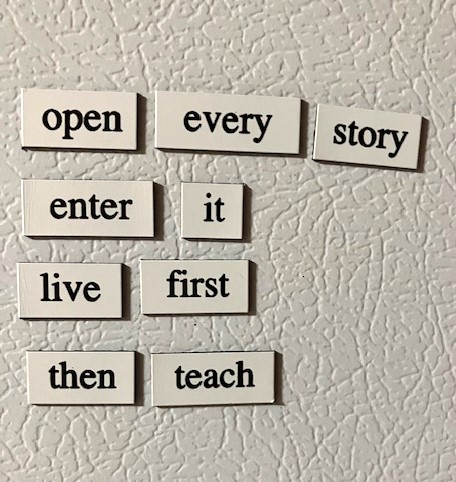
I made my first magnetic poem by pulling out a few magnet tiles:
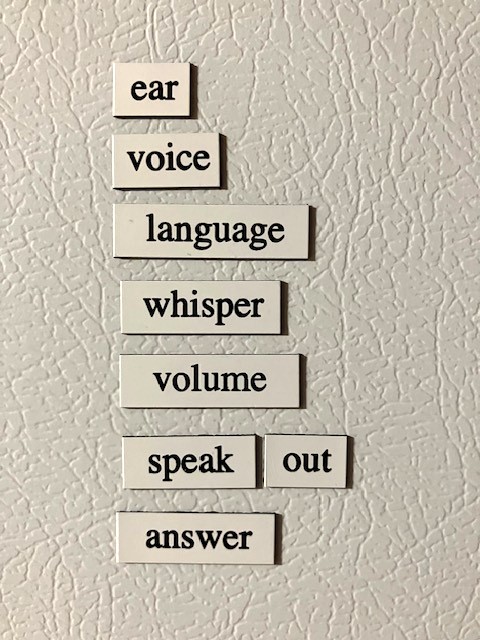
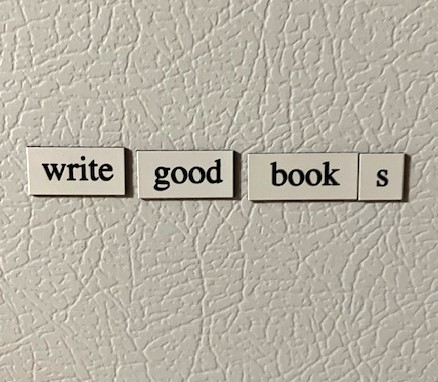
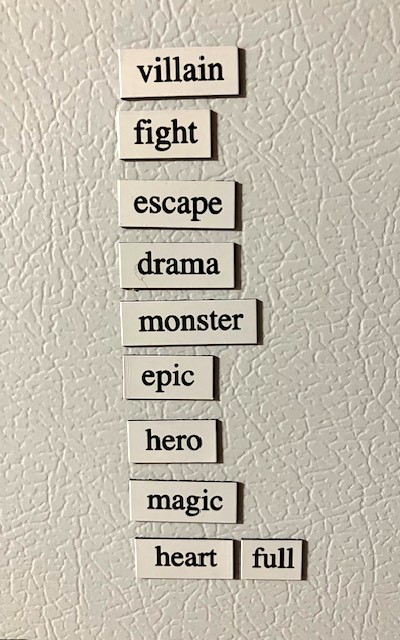
Ever since, I’ve been playing with the magnet tiles, crafting sentences and poems and snippets of who knows what. It’s playtime with words, nothing more. I can rearrange those magnets whenever I like, and the message they used to form will be gone forever. It’s nearly as impermanent as writing in the sand, except I, rather than the tide, control when the message will be washed away. Because there’s a finite number of words in the set, I’m limited in what I can say, and this makes it even more fun to work around the word I wish was there. (The set includes “dog,” but not “cat.” Can you imagine?)



If you’re stuck in your creative endeavor, how do you get yourself restarted? I’d love to hear some of your ideas. Do you shift to another medium, like baking or interior design instead of singing? Do you hunker down, pushing yourself until the logjam breaks? Do you take a complete break, or do you stick with your plan but use different tools, such as creating images with AI instead of drawing freehand? Share your experiences in the comments. Maybe your ideas will be helpful to another creative!

 P. Jo Anne Burgh
LOVE THIS ESSAY!!!
>
LikeLiked by 1 person
Thanks, Kay!
LikeLike