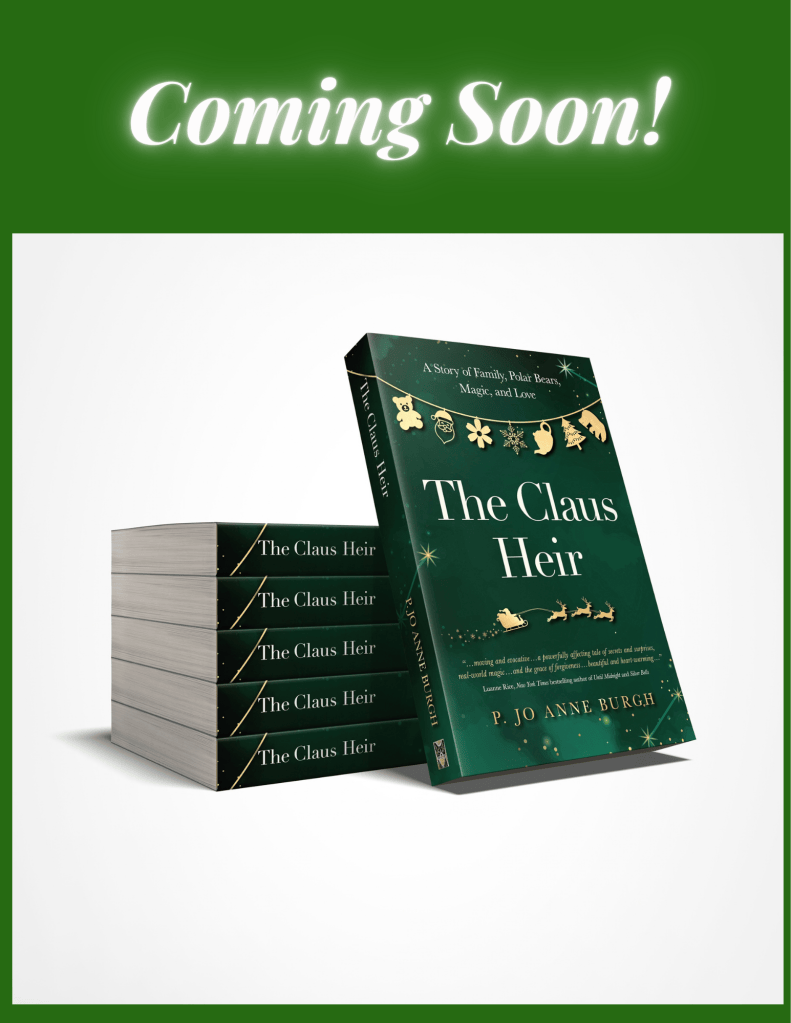
Less than five weeks until the official publication of The Claus Heir on November 10, 2026! So excited!
If you’d like to purchase The Claus Heir early, you have some options:
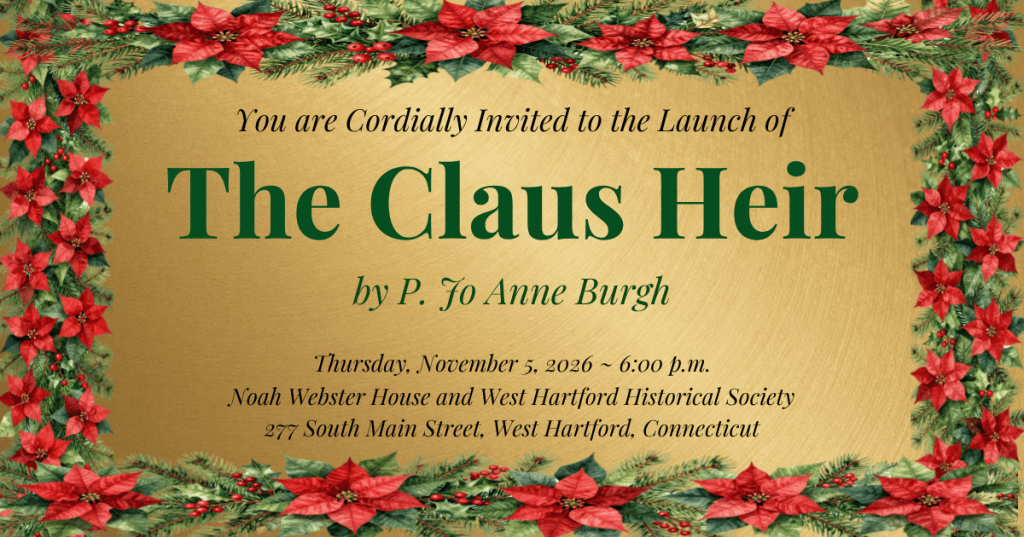
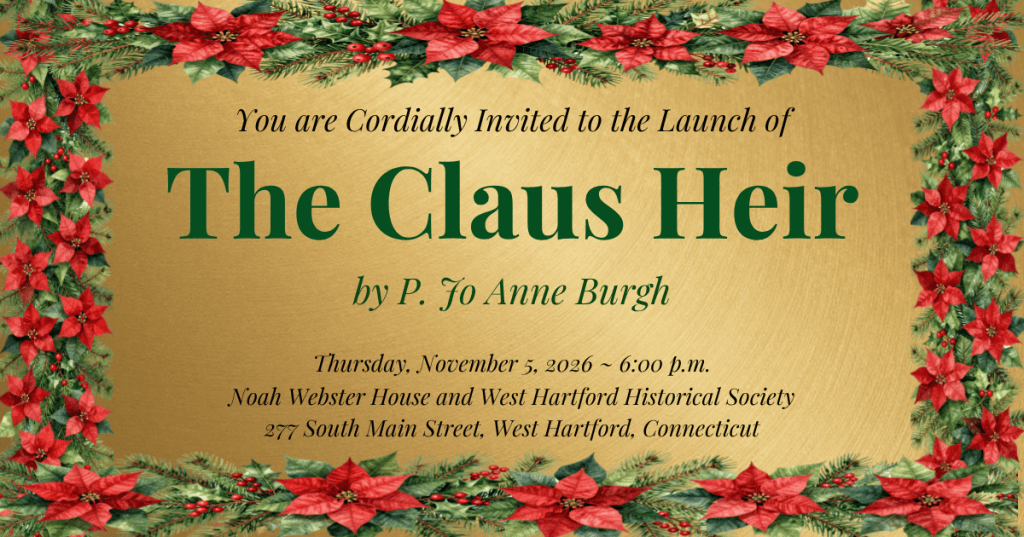
1. Come to the official launch at the Noah Webster House and West Hartford Historical Society on November 5! Copies of all three Claus books will be available for purchase and signing. Free admission, free parking, and a chance to listen and ask questions as noted interviewer John Valeri interviews author P. Jo Anne Burgh about writing in general and The Claus Heir in particular. (We promise: no spoilers!) See below for the invitation with additional details.
2. If you like ebooks, you can pre-order The Claus Heir on Amazon or Kobo, or at any of the retailers available on the Books2Read link, including Barnes and Noble, Apple, and several others.
3. If you prefer paperbacks, you can pre-order The Claus Heir through Bookshop.org. The great thing about Bookshop.org is that it lets you support independent bookstores. You can either designate the store you want to buy from, or you can simply buy it through Bookshop.org and let a share of the purchase price fund indie bookstores in general.
If you can’t make it to the launch, but you’d like to purchase the paperback version of The Claus Heir and have your book personally inscribed, there are ways to do this, too:
1. Come to any of the events listed on the Upcoming Events page.
Don’t forget—after November 10, Tuxedo Cat Press will be offering its annual free gift-wrapping service for books purchased directly from TCP, either through this website or at an event. Signed books make fantastic holiday gifts, so take advantage of the opportunity to wrap up (pun intended) your holiday shopping early!
Hope to see you at the launch and/or upcoming events throughout the holiday season! As always, thank you so much for supporting local businesses and independent publishers like Tuxedo Cat Press!
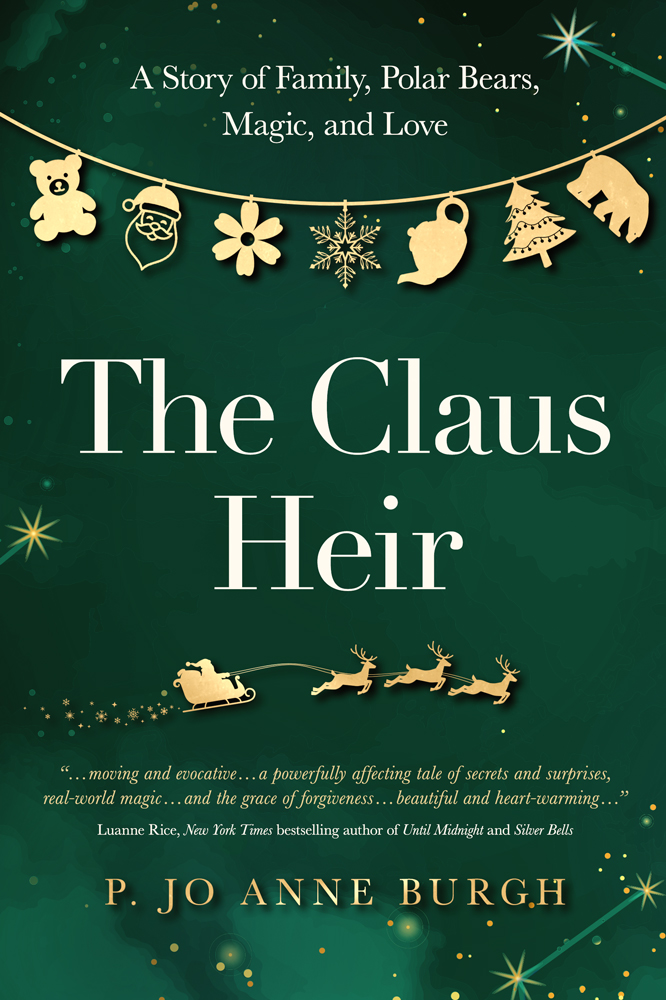
Voilà! Behold, the cover of The Claus Heir in living color!
(People of my generation will understand that reference. As for the rest of you—just smile and nod at the old folks.)
Credit for this beautiful cover goes to Andrew Brown, who has created all my book covers. Andrew and his wife Rebecca are Author Elevator. If you know (or are) an indie author who is looking for design services (among other offerings), I recommend Andrew and Rebecca highly.
Also, take a moment to read the lovely quote excerpt on the cover. Luanne Rice is not only a New York Times bestselling author of more than 30 books—she’s a kind and generous soul who also loves cats, tea, and books. Andrew only had room on the cover for an excerpt from Luanne’s quote, but here’s the full quote:
The Claus Heir is a moving and evocative novel about the turning point in the life of a couple who just happen to live at the North Pole. With wit and insight, P. Jo Anne Burgh examines married love, the desire to have a child, and what it means to be family. This is a powerfully affecting tale of secrets and surprises, real-world magic, the choices we make in the name of love, and the grace of forgiveness. What a beautiful and heart-warming novel Ms. Burgh has written. . . .
~ Luanne Rice, New York Times bestselling author of Until Midnight and Silver Bells
Isn’t that amazing? (I said she’s kind and generous!)
Lots more information to come, but here are some of the highlights:
The launch party for The Claus Heir will take place on Thursday, November 5, 2026, at 6:00 p.m. at the Noah Webster House and West Hartford Historical Society.
The Claus Heir will be officially published on November 10, 2026. (People coming to the launch can get the book five days early.)
The ebook of The Claus Heir is presently available for pre-order on Amazon. In days to come, I’ll be uploading it to other sites, including Kobo, Draft2Digital, and Barnes and Noble.
My event schedule can be found on the Upcoming Events pages on my author website and the Tuxedo Cat Press website.
Details will be available in the coming days, but in the meantime:
I’ve never been a fan of waiting. I come by this honestly. Dare I say, it’s genetic. When my older sister was in grade school, she interviewed our father for a class assignment. One question was what he disliked. His answer, which immediately became famous within the family: “Waiting and lumpy gravy.” I’m with him on both.
Last Thursday night, I sent my final (please, God) corrections to the person doing the interior design on my book. With one exception, all the corrections were misplaced hyphenations caused by her software. (Seriously—in what bizarre alternate universe would I ever hyphenate “Ryan”?) It was a fairly lengthy list, but they should all be simple enough. If she sends over the final proof tomorrow morning, I can review it, approve it, and call it done. (I was hoping she might decide to work over the weekend, but no such luck.)
The cover design is done. My cover artist (spouse of the interior designer) said in his Friday email that once I sign off on everything, he can send the final files.
In preparation, I tried to log into Ingram Spark on Friday. They wanted me to update my password. I tried, and tried, and tried again. Finally, I emailed them to ask what the problem is. I’m waiting for a response so I can be ready to do the upload as soon as I have the final book and cover files.
I already know Amazon is taking forever these days. I’ve ordered inventory of the other two books, and each order claims it will take 3-4 weeks. No idea what’s taking so long. I remember when the turnaround was 10 days. I’m presently living in terror about how long it will take to get a proof copy of the new book so I can place an actual order, plus how long fulfillment take, because the launch party is November 5 and I must have books for the party. But I don’t dare place an order for 50 books without reviewing a proof copy, because if they screw something up, I’ll have no recourse. Even at author copy prices, books aren’t inexpensive because even Prime members pay for shipping on author copies.
And did I mention that I have an appellate brief due this Friday and another due in two weeks? It’s just as well, because if all I had to do was to sit around and wait for proofs, files, book proofs, and deliveries, I’d likely go mad.
Some might encourage me to use this time wisely. The book is written. There’s nothing more to do there. So use this time to plan out some marketing (which, let’s face it, should already be in place), try to schedule more events, and do everything that needs to happen before Halloween because there will be no time later, like wash the windows, clean up the gardens, figure out year-end finances, schedule various home maintenance tasks (boiler inspection, leaf cleanup, and whatever I’m forgetting right now)—oh, and plan the launch party.
The launch party is a first for me, but I’m genuinely excited (except when I start panicking about the possibility of not having books). I’ve never done a book launch. My first novel, State v. Claus, came out during the pandemic, and nobody was doing in-person events, so I posted it and went on with my day. My second novel, Becoming Mrs. Claus, came out in 2023. While I could theoretically have had a launch, the final weeks before publication were fraught: my beloved orange cat, Ned, died, and my book designers and I were waiting until the last minute for the cover blurb because author William Kent Krueger, who generously blurbed the book, was on tour for his own recent release. At least it was simply a matter of uploading files and calling it released that time. (Also, that was when Amazon was turning around orders for author copies in days rather than weeks.)
I feel as if I should be putting this gap time to good use, except I don’t know what that good use is. Some authors might be starting a new book at this point, but those are likely authors who aren’t responsible for getting the books uploaded, ordered, and delivered by any particular deadline.
Mind you, I know that from certain perspectives, this is a lovely problem to have. Other people are waiting for far more pressing things, like my nephew who is need of a kidney transplant and is presently undergoing dialysis. If I don’t have books for my launch party, I’ll be mortified and crushed and attendees will be disappointed, but if he doesn’t get a kidney, the consequences are far more dire. Plenty of people are waiting to be paid for work they’ve performed or to receive court-ordered alimony and child support payments so they can meet their various obligations. People are waiting to hear about job opportunities, school admissions, and countless other decisions that could affect the course of their lives.
And so, as I wait for everything I need, I try to keep perspective. Yes, I dearly want to have everything in place for the launch party. Yes, it drives me nuts to have so little control over things like Ingram Spark’s tech glitches or Amazon’s slow production schedule. (No, Amazon does not offer the option of expediting an order. I’ve checked. Apparently, author copies are a low priority because they’re sold at wholesale and Amazon doesn’t make money on them.)
The only option to speed up an Amazon order is to order books as standard retail purchases and use Prime for shipping. (While this is more expensive than author copies, the author does have the option of setting the price wherever they choose.) While this would be a decent workaround after publication, it would require officially publishing the book weeks earlier than I planned. One of the perks of coming to the launch is that people will get the books before they’re available to the public, since the launch is November 5 and publication day is November 10. If I have to release early in order to have books for the launch, this incentive vanishes.
Another possibility is to use other printers, such as Barnes & Noble, who also offer print-on-demand and may be able to turn around an order more quickly. Even so, until I have final files in hand, I can’t do anything.
They say waiting builds character. Being powerless teaches you patience and faith. Having no control helps you to realize what’s truly important.
Maybe they’re right. Maybe all these things are true. Maybe the current circumstances will make me a better, stronger person.
I don’t care. I want my books in time for the launch. I don’t mean to whine (although I know I sound a little bit whiny—or maybe more than a little bit.) It’s not even just so I have the books to show everybody. The real reason—and this is God’s honest truth, not an attempt to make myself sound less whiny—is that I don’t want to disappoint the people who are coming. Those generous folks are coming because it means something to them to support this local author and/or to have my new book a few days before the rest of the world. These people are incredibly kind, and I want to be able to put this book into their hands. I want to give them this tangible evidence that I appreciate their coming out on an evening in November, after autumn darkness has fallen, when they could very reasonably have decided just to go home and watch television and wait a few more days to order the book. Whether the party consists of six people or 30 (and I seriously doubt there will be as many as 30), I will be enormously grateful to them for coming, and I want them to have the tiny benefit of purchasing the book before anybody else on the planet, just because they’re special and I want them to know it.
In the end, it comes down to this: I wrote the book. That’s the part I controlled. From here on out, the vast majority of what happens will depend on other people.
It’s been an insane month, with even more to come this week. Deadlines, appointments, demands. Everybody wanting something. Inadequate rest, especially on the nights I’m staying over at Mom’s because one of her overnight caregivers is taking a three-week vacation. (Seriously? Who gets three weeks off?) This weekend has literally been the first since June that I haven’t worked at my day job (although I probably should have, because I have two projects due this week that I haven’t begun, in addition to medical appointments, a client appointment, treks to the post office and the bank, Bible study, a friend’s book event, and I think there’s something else I can’t recall right now).
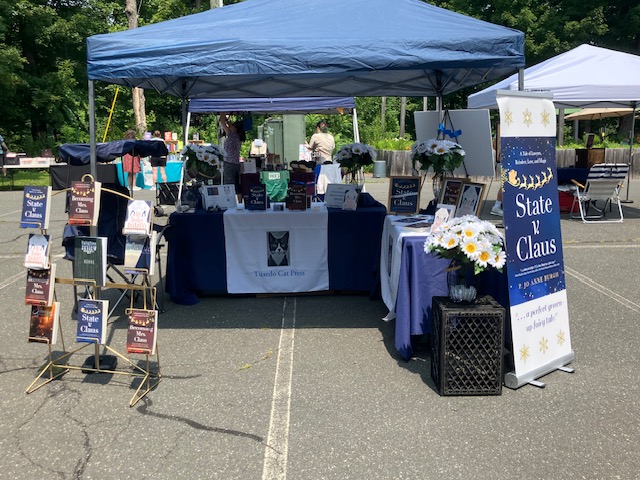
Yesterday was a book event in Old Wethersfield, Connecticut, which in my opinion should be named the Most Bookish Town in Connecticut. These people don’t just browse—they come to buy. I toted the same bins of books to this event that I’d taken to two prior events and hauled home again with barely a book sold. This time, I not only sold out of State v. Claus, but I took orders for four copies (which explains tomorrow’s trek to the post office). The event ended at 3:00 (an excellent ending time in my opinion, since it allows for breaking down my tent and display, loading the car, getting home, and doing it all before it’s time to feed the cats their dinner). But as it turned out, I was so exhausted last evening that instead of swimming, I lounged on the porch with a glass of ice water until I had the energy to move inside and stretch out on the sofa.
As I write these words, it is still late spring according to the meteorological calendar. We’re approximately two-thirds of the way through June. Local temperatures for the next week are expected to range from the low 60s (with a couple of high 50s thrown in) to the mid- to upper 70s. School years are ending. Construction equipment clogs nearly every road. Air conditioning in most public places appears to be set to “frigid.” A peaceful dinner on the porch is generally accompanied by the roar of a lawn mower or the whine of a weed whacker.
Which is why it came as a slight surprise on Wednesday when I received an email from the organizer of one of my favorite holiday market events.
Over the past few years, I’ve developed a routine when it comes to book events. I generally refrain from scheduling in the first few months after the holidays for several reasons. First, I’m exhausted after the crunch of the holiday season. Second, I’m usually recovering from whatever illness I contracted during the holiday season as a result of the crowds. Third, this down time is my prime season to do some actual writing. Fourth, one result of writing seasonally-themed books is that there’s very little demand in the first few months of the new year.
Mind you, I do a few warm weather events. Last weekend was my first of the summer. Unfortunately, the event wasn’t well-marked, and relatively few people found their way into the private room where a dozen or so authors were set up. I have another event tomorrow, and I have reasonable hopes for a good turnout and maybe even some decent sales. (If you’re in or around East Longmeadow, Massachusetts, tomorrow afternoon, come by Brew Practitioners to sip and shop. It’s going to be a lovely day!)
Today is my twenty-ninth anniversary as a self-employed person. (File this under “things that make no sense.”)
On May 30, 1997, I walked out of my old firm for the last time. Three days later—Monday, June 2, 1997—I awoke as a self-employed person, doing research and writing for other lawyers. I had one client and a box of business cards. No alimony, no trust fund, no independent income. In the corner of my living room sat the desk my parents bought for my bedroom in 1968. A computer sat on that desk, a hand-me-down from my father’s office that was still connected to the dial-up modem I’d used four years earlier, when I was in law school.
Last night, I started editing Draft #5 of my new book. It felt like coming home.
* * * * *
This weekend is the Palm Sunday service. I’m thinking seriously about staying home and watching the livestream, because I don’t like how they begin by going outside and marching through the neighborhood, waving palms and singing. I know it’s supposed to be symbolic and powerful, but when I did it a few years ago, I felt conspicuous and self-conscious. If I lived in one of the apartment buildings overlooking the sidewalk in front of the church, I’d wonder why those idiots were traipsing around underneath my window.
* * * * *
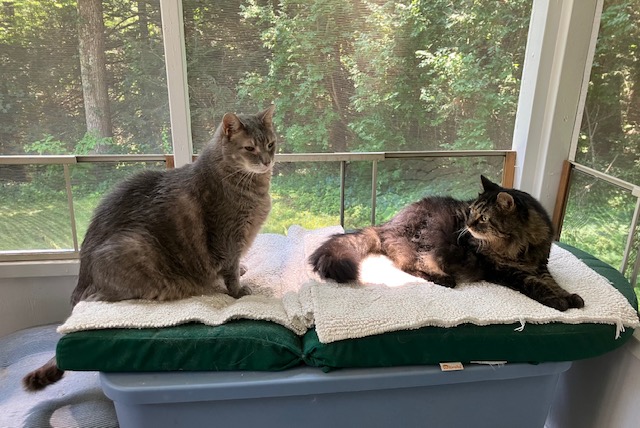
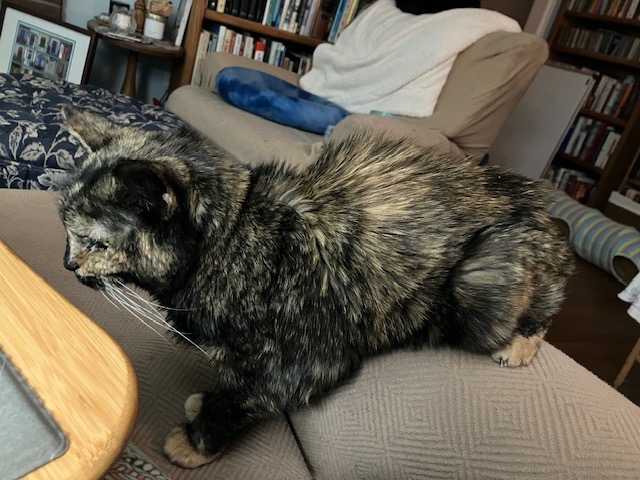
Next week, Olivia will turn eighteen. It feels so unreal. I remember her as a kitten who barely fit in my hand. Now, she’s going to be old enough that if she were human, she could vote.
This must be how parents of human children feel when their offspring drive away and it doesn’t make any sense because just this morning they needed help tying their shoes.
For years, I’ve been listening to Joanna Penn sing the praises of using artificial intelligence [“AI”] to assist in various aspects of the writing and publishing process. Last week, I took the plunge (sort of).
Draft #4 of my current novel is fairly massive. As I worked on Section 3, I found myself wishing I had an outline of all the chapters and scenes to that I could ensure that I wasn’t repeating something I’d written weeks ago and that I wasn’t skipping over something I’d meant to drop in. If I were a best-selling and/or wealthy author who has an assistant, I’d ask my assistant to prepare the outline. As it was, I started an outline a few months ago, and the time it took sketch out just a few scenes made it clear that the task would not only be onerous, but would eat into time I’d rather spend writing.
Maybe it was listening to Joanna’s podcasts about using AI as a tool, but finally, I decided the time had come to be brave. I already had the free version of ChatGPT, so I asked it to outline Section 1 of the book. (The three sections are separate Word documents.) ChatGPT produced summaries of the first two chapters before informing me that I’d exhausted the capacity for the free version and I’d have to wait 24 hours for it to reset.
At this rate, it would take at least three solid weeks to get this outline, and likely longer. Rather than keep coming back every day for another chapter or two, I began researching other AI products to see what else had the capacity to outline a manuscript without being exorbitantly priced. ChatGPT had urged me to upgrade to its $30/month level, but I couldn’t tell how much of the book it would outline even then. I spent a few days trying to decipher AI lingo, including such terms as token and harness, and to sort out the parts I needed to care about.
Last night, I wrapped up Draft #4 of my novel-in-progress. It’s still long—about 15,000 words longer than my other books—and I know it needs tightening. But it’s a substantial improvement on Draft #3, and that counts for a lot.
Writers argue vigorously over the premise that a writer must write every day. Some insist that we must write daily to keep the pump primed. In On Writing, Stephen King said that he tells interviewers that he writes every day except Christmas and his birthday because he thinks that makes him sound normal, but the truth is that he also writes on those days. If you google “must a writer write every day?”, you’ll find dozens of posts defending both the sides of the debate.
The truth, I think, is that you need to do what works for you. If writing every day keeps you in touch with the work, the ideas, the muse—then yes, write every day. If you can maintain your thoughts about the piece even if you skip a day every now and then, take your breaks. If you can—or need to—take weeks or months off after large projects, do what you need to.
Last night as I prepared dinner, I listened to an interview David Marchese of The New York Times did with celebrated author George Saunders.* During the interview, Saunders was talking about his new book, Vigil, as well as other issues such as his personal beliefs. When he was discussing how his childhood Catholicism affects his work, he talked about the experience of writing a character whom he initially disliked and how, as he tried to make the language about the character more interesting, concepts such as liking or dislike the character become “almost useless phrases.” Then, he spoke the words that have stayed in my mind: “Specificity negates judgment.”
In all candor, as I pondered the interview last night, I thought he said a lot more about specificity in writing. It wasn’t until I went back to the printed version of the interview today and searched for “specific” that I discovered this was his only statement on that particular point. But it didn’t matter, because when he said that, he reminded me of something I’ve long known but had somehow managed to forget: good writing is specific.
Think about it. If I tell you a character wore a green shirt, your idea of what that character is wearing may be very different from what I mean. Those words—green and shirt—are so imprecise that without more, your mental image of the character’s appearance will likely be very different from what I intend. Your imagination may clothe the character in a pine-colored button-down corduroy shirt with leather elbow patches and a pocket in which he always keeps a pen, or a short-sleeved blue-green knit polo shirt with a tiny pink polo player stitched onto the left breast, while I meant to dress him in a fluorescent lime-green T-shirt bearing the ghost of a stain from the chili dog he ate two weeks ago. Each of these is indeed a green shirt, yet each speaks very different volumes about the wearer.
General is benign; specific is dynamic. Armed with this reminder, I returned to editing my current book. As I reviewed each scene—each sentence—I sought to oust the general in favor of the specific. For example, a cluster of three interns—a generic, faceless group—became three individuals with distinctive characteristics. They weren’t major characters, so I didn’t devote enormous space to them, but on this pass, I provided enough detail that the first-person narrator (who never learned their names) could easily tell us which was speaking: Glasses, Acne, or the cheerleader. (If the names she assigns them sound a tad judgmental, that reveals something about the narrator.)
I finished this round of edits on the first section of the book last night. Since I only had the revelation about specificity around page 90, I’ll need to go back to the beginning to see what I can tweak in the name of the specific. For now, though, I plan to continue moving forward. In its way, the first section was the easiest, plotwise. I need to gird my loins to address the second and third sections, where character relationships will become more complicated and I’m juggling the unexpected and the inevitable. (No, I will not be more specific at this point.)
But as I edit, the reminder to be more specific will remain with me. Also, as I work with a particular character who would be very easy to judge, I’ll bear in mind George Saunders’ comment that specificity negates judgment. Maybe if I focus on specific aspects of that character, I’ll find that I’m not quite so inclined to judge them. And maybe, if I do this well enough, you won’t judge them, either–and maybe the narrator won’t, either. We’ll see.