
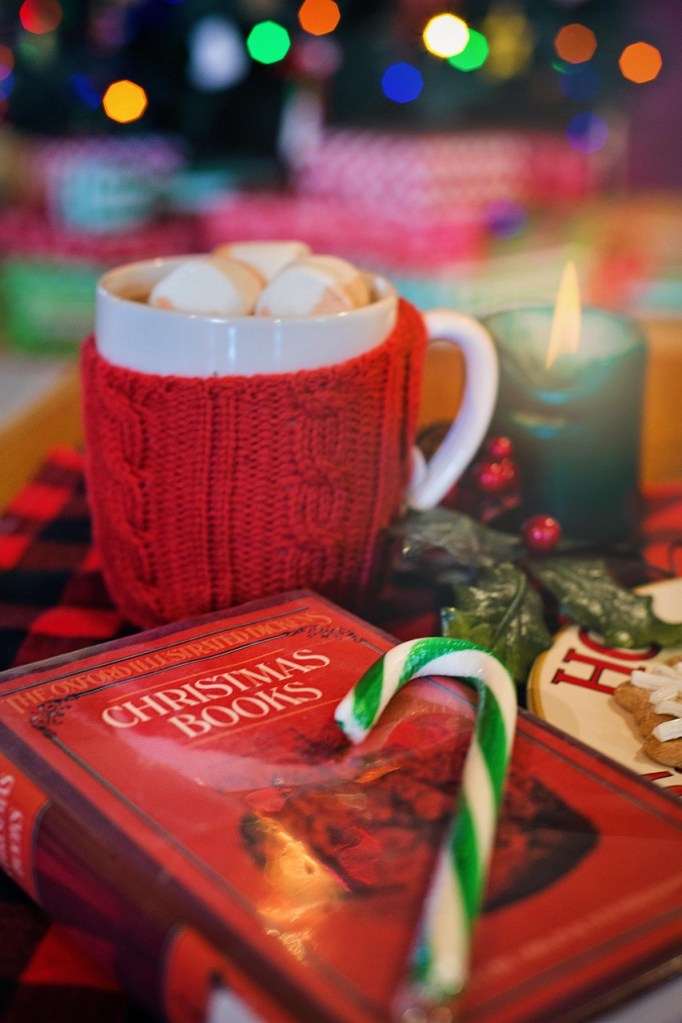
It’s Christmas Eve. All the ordering (and returning and re-ordering) is finished. All the errands—purchasing gifts and cards and wrapping paper and gift bags, all the packing and mailing of gift boxes, all the shopping for holiday meals and parties and events—it’s all done. At least, it’s as done as it’s going to be, because all the stores have closed for Christmas.
Which means that it’s time for a respite. That respite is Jolabokaflod.
Originating in Iceland, Jolabokaflod translates approximately as “Christmas book flood” or “Yule book flood.” It’s a cozy holiday tradition celebrated on Christmas Eve. For Jolabokaflod, everyone exchanges books as gifts. Then, they spend the evening snuggled up with their new books and hot chocolate or other festive drinks, savoring the peace of the evening and the company of loved ones as they immerse themselves in stories.
According to most sources, Jolabokaflod dates back to World War II, when paper was one of the few goods in Iceland that were not rationed. As a result, books became popular gifts. For the 1944 holiday season, the Icelandic Publishers Association created the first Bokatidindi (book news), a catalogue listing every book published in Icelandic that year. Copies of the catalogue were (and still are) distributed at no cost to every household in the country so that shoppers can choose titles to give their family and friends for Christmas. Books are, of course, one of the best holiday gifts available: they’re easy to wrap, not overly expensive, and simple to transport—plus, they satisfy the reader’s thirst for new tales. To this day, the Bokatidindi is distributed in November each year, and the vast majority of Iceland’s book purchases are made during the final months of the year.
Also, Iceland is one of the most literate nations in the world. One source cited a study from 2019 showing that the average Icelander reads 27 books per year, as compared to Americans who read an average of four books. The most avid readers are women and families with children, and Icelandic youth frequently read languages other than Icelandic. Even more impressive is that approximately 1 in 10 Icelanders will publish a book in their lifetime, and Iceland publishes more books per capita than any other country.
Every two years, the Reykjavik International Literary Festival celebrates books and authors from Iceland and many other countries. This year’s festival (which, sadly, we’ve all probably missed unless we had the great good fortune to be in Reykjavik last month) included author talks and panels with Claire Keegan (Ireland), Abdulrazak Gurnah (Great Britain, Tanzania), Anne Carson (Canada), Andrev Walden (Sweden), Hernan Diaz (U.S.A.), and Caterina Zaccaroni (Italy), as well as Brynja Hjálmsdóttir and Einar Lövdahl of Iceland—not to mention publishers and other guests from around the world.
To the surprise of pretty much nobody, Jolabokaflod has sparked the imagination of people around the world, including the U.S. While you can put your own spin on it—celebrate on Christmas Day instead of Christmas Eve, sip adult beverages with your books instead of cocoa, include an array of snacks or holiday treats, exchange pre-loved books instead of new ones—the basics are simple. All you really need to celebrate Jolabokaflod are a book, something delicious, and a peaceful space where you can immerse yourself in a fantastic new tale that will transport you from the hustle and bustle of daily life into a world where your imagination can run wild.
P.S. If you’re looking for seasonally-themed stories, I humbly invite your attention to my own books, State v. Claus and Becoming Mrs. Claus. Because there’s still time to obtain both titles—personally inscribed, if you like—before Jolabokaflod officially begins.
*****
If you’d like to learn more about Jolabokaflod and the Icelandic literary tradition, these are some of the sites I relied on in preparing this post:


Very interesting. Thanks for sharing. Wishing you wonderful holiday season.
LikeLiked by 1 person
Thank you! Same to you!
LikeLiked by 1 person