
As I write these words, it is still late spring according to the meteorological calendar. We’re approximately two-thirds of the way through June. Local temperatures for the next week are expected to range from the low 60s (with a couple of high 50s thrown in) to the mid- to upper 70s. School years are ending. Construction equipment clogs nearly every road. Air conditioning in most public places appears to be set to “frigid.” A peaceful dinner on the porch is generally accompanied by the roar of a lawn mower or the whine of a weed whacker.
Which is why it came as a slight surprise on Wednesday when I received an email from the organizer of one of my favorite holiday market events.
Over the past few years, I’ve developed a routine when it comes to book events. I generally refrain from scheduling in the first few months after the holidays for several reasons. First, I’m exhausted after the crunch of the holiday season. Second, I’m usually recovering from whatever illness I contracted during the holiday season as a result of the crowds. Third, this down time is my prime season to do some actual writing. Fourth, one result of writing seasonally-themed books is that there’s very little demand in the first few months of the new year.
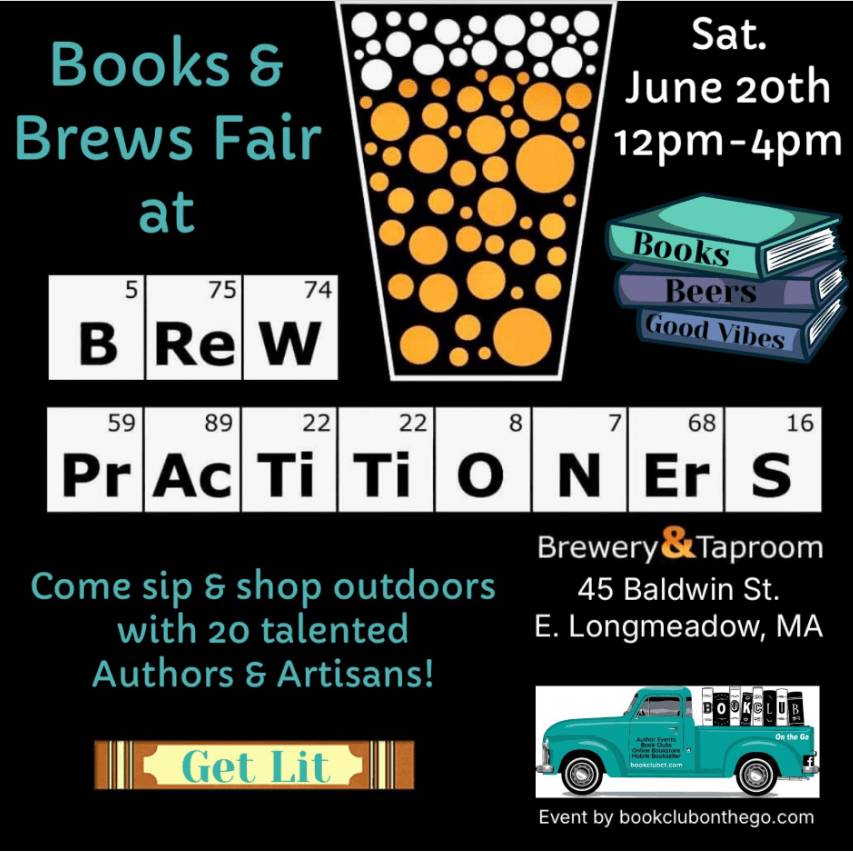
Mind you, I do a few warm weather events. Last weekend was my first of the summer. Unfortunately, the event wasn’t well-marked, and relatively few people found their way into the private room where a dozen or so authors were set up. I have another event tomorrow, and I have reasonable hopes for a good turnout and maybe even some decent sales. (If you’re in or around East Longmeadow, Massachusetts, tomorrow afternoon, come by Brew Practitioners to sip and shop. It’s going to be a lovely day!)
But back to the holiday event email. I’ve done this particular event three times, and it’s always been a special favorite of mine for several reasons. First, unlike all the others I do, this one was an evening event. I always had the good fortune to be placed in the antique barn which also houses the silent auction, the purveyors of alcohol, and the rest rooms, as well as boasting light and heat. I’m certain this is one of the reasons my sales at this event were always excellent, i.e., people have sufficient warmth and light to take off their gloves and flip pages. The tree lighting outside made the atmosphere festive. The less-fortunate vendors set up tents on the closed-down street in much the same way I will be tomorrow afternoon, except that unlike me on this mild June day, those poor souls had to provide their own lighting and figure out some way to stay warm. Last year, midway through the evening, temperatures dropped so far and so fast that revelers began to crowd into the barn and the event ended up shutting down an hour early.
To avoid a repeat of this scenario, someone has now decided that instead of the first Thursday evening in December, which has been the time-honored tradition, the event will take place on a Saturday afternoon. For me, this is a scheduling disaster. The chosen Saturday afternoon conflicts with another excellent event I’ve done for the past two years and would love to do again this year. To add insult to injury, it turns out that there’s something scheduled for the barn, which means all vendors will be on the street. Since the event will last until 6:00 p.m. in a season where the sun sets around 4:30, everybody out there will need to plan for lighting as well as figuring out how not to freeze (no space heaters permitted).
So I did what any reasonable person would do: I contacted the organizers of the event that usually occupies that weekend to ascertain my options. To nobody’s surprise, at this point in June they haven’t quite gotten around to working out the fine points of their holiday plans. They assured me that they planned to confer on the matter in the next couple of weeks and would likely be able then to provide additional information.
As I said, the erstwhile Thursday evening event has always been a good one for me. If I lose it, my sales figures will take a substantial hit, especially this year when I have a new book coming out and I was counting on my regulars at that event. So as the late spring sunshine poured through my windows and the tabletop fan gently moved the air, I began searching online for other holiday markets to add to my schedule. Somewhat surprisingly, this is not as easy as it might seem. At one extreme are the holiday fairs and market that haven’t even decided whether they plan to operate again this year. At the other extreme are the ones that are nearly fully booked, including one I queried yesterday; this morning, I received a responsive email saying that they had a few spots left in the hallway and that I should submit my application promptly, as decisions will be made by July 1. (Needless to say, I immediately stopped working on my brief and submitted my application.)
In fairness, I already have two confirmed holiday events on my schedule. I booked one of my larger events in April, but the one is run by a professional event organizer. The other, which benefits Protectors of Animals, takes place the Saturday before Thanksgiving; the POA Holiday Fair is always on my calendar, no matter what.
If you’re a local author, an artisan, or a crafter, and you think you’d like to participate in a holiday market or fair, here are a few suggestions based on my experience:
- Start your research now. It is not too early. In fact, for some holiday events, it may be too late to do more than get on a waiting list. This is a time when the internet can be your best friend: google “holiday markets” and your state (or wherever you’re willing to travel to), and see what shows up. A few more clicks should lead you to contact information for the organizer.
- Figure out your budget. Most events will charge a participation fee. Depending on the size, length, and reputation of the event, the fee may be minimal or it may be substantial. (For perspective: I’ve seen fees of $35 for a simple four-hour event and $800 for a huge three-day extravaganza.) Work out how much you’ll need to sell in order to cover the event fee and other expenses so you can decide whether it’s worth the cost. The fee is only one of the expenses, but it may be your dealbreaker.
- Order your merchandise well in advance. Few things are as frustrating as having the day of the event draw near, but you don’t have enough copies of your book or sufficient materials to make your wares. Some people think that running out of merchandise should be your goal (“Look! I sold out!”), but for me, there are few things as nightmarish as having to tell a potential customer who’s standing in front of me, ready to buy my books, that I have nothing to sell them. (I only came close to this once. Luckily, the event took place just a few miles from my house, and I was able to call friends to bring me another box of books.)
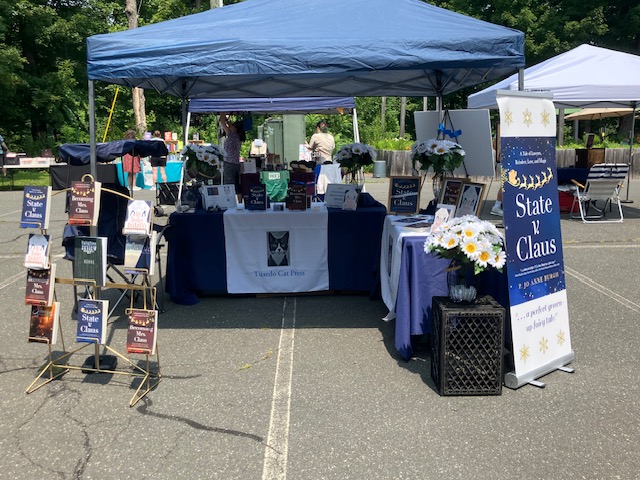
- Decide what you need to take. This evening, I loaded my car for tomorrow’s event. Since it’s an outdoor event, I’m taking my foldable tent, tables, chair, retractable banner, display rack, easel, and a large foamcore sign. (Note: don’t assume you’ll remember everything without a list. It wasn’t until I was typing this paragraph that I realized I’d forgotten to pack the sign and its collapsible easel.) I organized the bin containing décor—tablecloths, table runners, framed book covers, information signs—as well as the books themselves, the cash box, pens (multiple) for signing, phone charger, note pads to track sales, tools (painter’s tape, clips, box cutter), bookmarks, and business cards. Since it’s a summer(ish) event rather than a holiday one, I decorate my display with wire vases (weighted with bags of beads) and stems of large daisies from a local craft store; by November, I’ll be using battery-powered fairy lights and gold-brush Christmas trees (Home Depot and the craft store, respectively).
- Whenever possible, try to find bargains or borrow items. When I did my first event, I borrowed a table and chair, and I bought a cash box. The next year, I bought my 4-foot table at Home Depot, but I found my 6-foot table on Buy Nothing. Craft stores often run substantial sales and offer discount coupons. I bought my tent from a friend who was upgrading hers. I originally purchased my foldable wheeled cart for use at Tanglewood, but I repurposed it for book events. My display rack came from a store-closing sale, and it cost $10; the spray paint I used to transform it from black to gold cost more than the rack itself. Learn to use tools like Canva (which has a free version) so you can make your own signs. Take your own beverages and snacks (especially important if you don’t know what the food/drink options will be).
- Know your limits. It may take a little while to figure this out. Using my event tomorrow as an example: it runs from noon to 4:00, so no big deal, right? Except that this evening, I spent an hour organizing everything and loading the car (which I was able to do because I have a garage). Tomorrow, I’ll need to get up early, plan on time to stop for gas, and travel the 45-minute trip (construction permitting) in time to arrive by 10:30 for setup. Breaking down at the other end and loading the car will likely take at least half an hour, followed by another 45-minute trip home. (Depending on my energy, I may not unload until Sunday.) Realistically, therefore, this four-hour event will be at least an eight-hour day, and there’s a fair bit of physicality involved. (If you’re fortunate enough to have a family member or friend who is willing to donate the day with you and to help out, the setup/breakdown will be more efficient, but the 45-minute round trip will won’t be any shorter.) If you’re like me and your books or products are seasonal, you’ll have to take that into consideration, for better or worse (such as if you’re debating whether to do an outdoor event in December). Ditto if you’re not as youthful as you used to be. You won’t regret pacing yourself.
- Spread the word. I’ve participated in several multi-author events where no one came. There are any number reasons for this. Reason #1 is usually that the event wasn’t well-publicized, at least not among people who would be willing to travel the distance involved. Some are in unfortunate or remote locations. (I took part in one ill-fated event at a local outlet center. What the organizer failed to disclose was that the center was nearly vacant because the property owner had plans to demolish the existing buildings and create a community of apartments and new stores. As a result, 45 authors wasted an entire day hanging out, going to each other’s readings, and grumbling about the absence of the promised food options.) Some events are publicized, but they suffer from poor signage so that people breeze past the driveway or the walkway, completely unaware that just a few feet away, local authors and artisans are hungry for their business. If you’re not organizing the event, your control over some of these factors will be limited, but you always have the ability to use your social media presence to remind people that you have an event coming up. Also, always include the address of the event so people can plug it into their GPS. Nobody can attend an event they can’t find.
- Maintain an updated events page on your website. If you have a website—and if you’re an author, you should—be sure to have a page where people can easily find your upcoming events. It’s not just for their benefit, either; I’m only half-kidding when I tell people that I always update my events page so I know where I’ll need to be. Your page should include, at a minimum, the following information: event name, date, hours of operation, and address. If there’s a flyer, include it, too. If there’s special information, such as author readings, note the time you’ll be reading.
So, that’s what I know at this point. If you have any questions, please feel free to ask, either in the comments or by sending me a message. And if you’re going to be in the neighborhood of East Longmeadow, Massachusetts, tomorrow, I’d love it if you stop to say “hi!”


A lot of great information. It sounds like a lot of hard work. Wishing you good luck with your events and sales.
LikeLiked by 1 person
Thanks so much, Joseph!
LikeLiked by 1 person