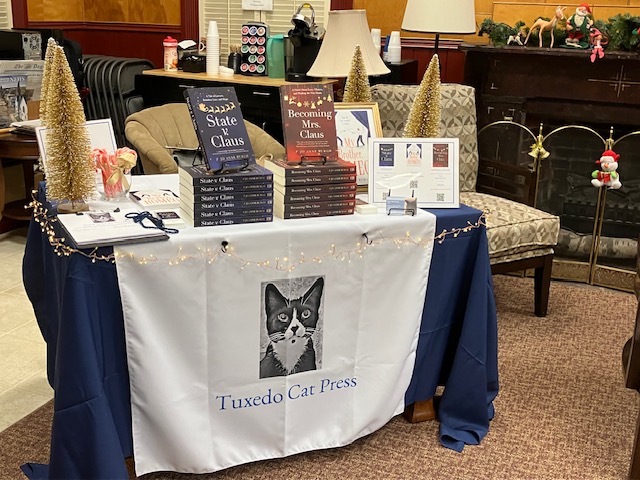
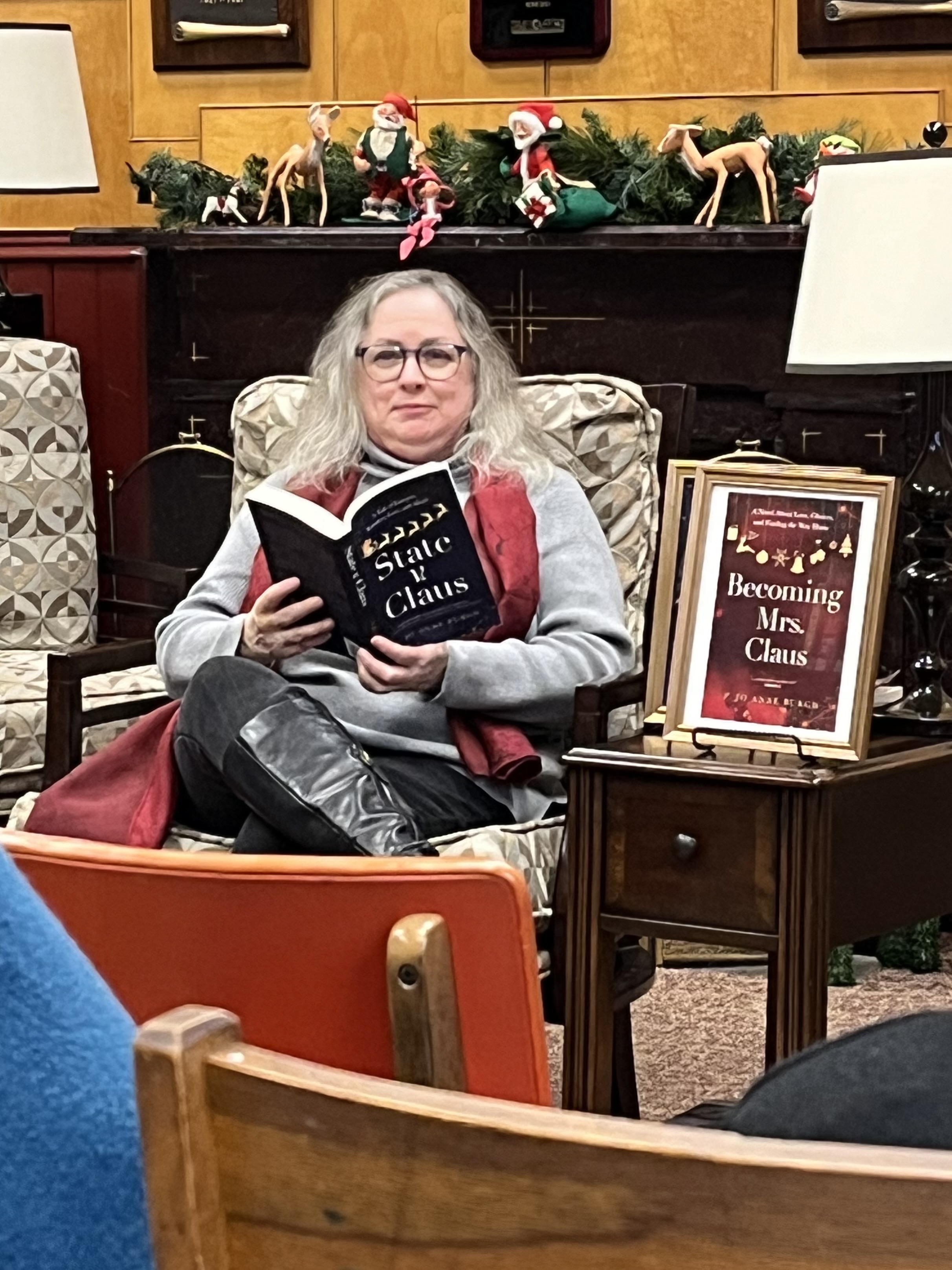
Reading at Raymond Library, Oakdale, Connecticut—November, 2023
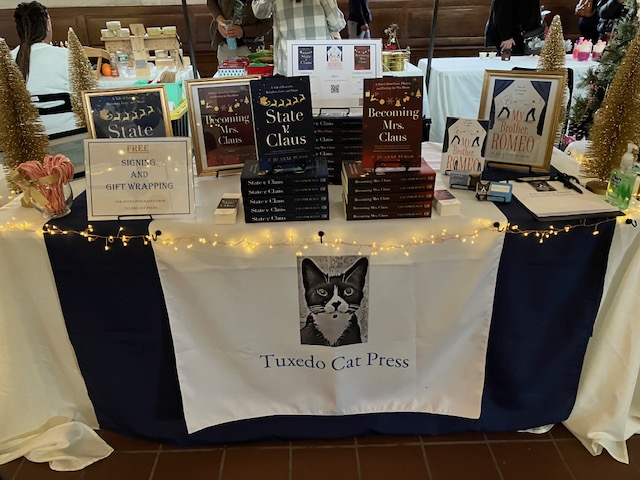
Even though October has several days left, the Season is officially under way. Opportunities to join events where I can sell books, whether exclusively for authors or with broader appeal, are coming thick and fast. On Tuxedo Cat Press’s website, the upcoming events page is being updated at least once a week.
This is now my third holiday bookselling season, and so I’d like to share with you a few more things I’ve learned—and continue to learn—about managing some specific aspects of the Season:
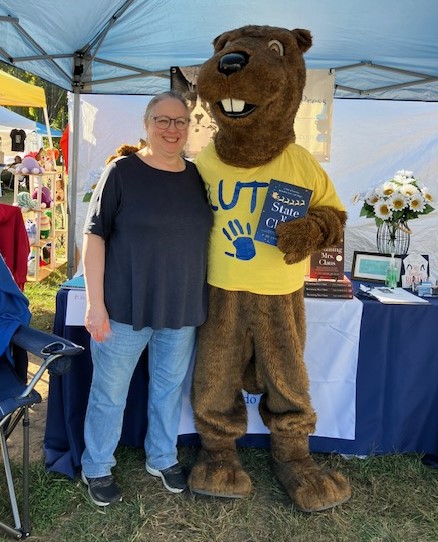
Last weekend, Tuxedo Cat Press had a tent at the South Windsor Apple Fest. I had no idea how popular the event would be, but I hadn’t done an event in two months, so when another author had to bow out and offered me her spot, I signed up. I figured I’d hang around, talk to some people, and maybe sell a couple of books.
It was a long day, to be sure. I arrived at 7:15 a.m. to set up, and I didn’t get home until nearly 7:00 p.m. But it was a good, fun, and productive day, complete with perfect New England autumn weather and a visit from Chuckles, the official mascot of the Lutz Children’s Museum (and my neighbor). Best of all, sales were excellent, which always makes for a good event.
In two weeks, the Season begins in earnest. This weekend and next are my last unbooked ones until after Christmas. I recently confessed to someone that one of the main reasons I keep my Upcoming Events page on Tuxedo Cat Press’s website up to date is that otherwise, I’m likely to forget where I’m supposed to be, much less when.
Some authors don’t like to do fairs, holiday markets, and other types of events that aren’t “literary.” It’s all a matter of what you like, I suppose. That, and whatever works.
Back in the spring, as I approached the end of my 100-day challenge, I wrote this:
There’s a part of me that’s scared that if I stop writing every day, I’ll lose my momentum and the story will fade from my imagination. I want to believe that a hundred consecutive days of writing will protect it, but I’m not certain. . . . I’m afraid to take my hands off the wheel for fear the story will stall out.
Turns out, I was right.
I kept writing 1,000 words each day for nearly two weeks past my challenge date. Then one night, I gave myself a break. I was entitled, I thought. I was tired. I needed to pause the writing, to organize what I had so I could figure out what I still needed. I’d been writing in chunks, and I took some time to move the chunks to Scrivener so I could arrange and rearrange them in some sort of order.
This was good and helpful work, or at least it felt productive at the time. Shifting from creating to organizing helped me to discern what existed and where the gaps were. Next, I would sit down and explore the existing work to figure out how to fill those gaps.
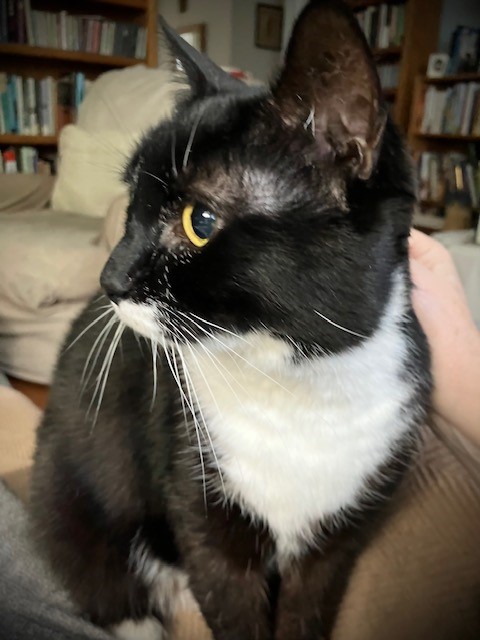
Friday evening. On the sofa with three cats. The fourth is snoring in her perch directly behind the sofa. On this peaceful evening, I contemplate my weekend plans.
Tomorrow, the weather is supposed to be beautiful. The rain that has soaked us today will move out, leaving my little corner of the world sparkling and fresh. My plan is to go to the Florence Griswold Museum to see their current exhibit, “Impressionism 150: From Paris to Connecticut and Beyond,” as well as other exhibits and works on display, have lunch in their café, and stroll around the gardens and the grounds.
It’s been many years since I’ve been to the museum. Strange, really, because there was a time when I went down to Old Lyme at least once or twice a year, whether for brunch at the now-closed Bee and Thistle Inn or to visit the Florence Griswold Museum. I once went down on a Saturday, having seen Girl with a Pearl Earring the night before; the movie had just come out, so that would have been 2003, more than twenty years ago. Was that the last time I was there? I’m not even certain.
Charlotte, who sat with me nearly every night as I wrote. Such a good girl!
Reader, I did it.
For 100 days, from April 1 through July 9, I wrote at least 1,000 words of my novel every single day. At present, the manuscript, which is most definitely not done and will require substantial editing, is 109,822* words.
My reactions are mixed. Part of me is flabbergasted that I made it for the entire 100 days without missing a single one, even on the infamous weekend when I wrote after I stopped work at 3:35 a.m., crouched over my Surface as the cats slept beside me on the bed. Another part of me says, “Of course you wrote. You’re a writer. That’s what writers do. And P.S., you still have a lot more to do.”
Here in the U.S., Independence Day was last Thursday. Many office workers were able to take Thursday and Friday off, resulting in a four-day weekend. Miraculously, my calendar behaved, and so I was one of those office workers. As a result, for the first time in longer than I can remember, I got a decent chunk of truly good rest. For four full days, I left the house only three times: a previously-scheduled massage, church Sunday morning, and mom-care Sunday evening. Other than that, I slept late, read, and did some organizing—and, of course, I wrote.
I’m in the final days of this challenge. I’ve written at least one thousand words of my new novel every day, all through April, all through May, all through June. Now, on the cusp of July, the finish line is in sight.
I think that this time, I’ll be ready to pause the word count.
It’s not that there isn’t still a lot to write. If I wanted to, I could probably go for at least another three weeks and not run out of material. But I’m tired. I need a break. Besides, rather than simply keep writing, I’m thinking I need to spend time going through what I’ve written, piecing it together to figure out where the holes are. So I’ve promised myself that for the next nine days, I’ll continue to write what I think needs to be written, and I’ll keep making notes as other pieces come to mind. After July 9—Day 100—I’ll get out the whiteboard and chart what I have so I know what I need to complete Draft #1, and then I’ll fill in those gaps.
Today was a beautiful day: clear, dry, even slightly cool as evening fell. Considering nasty-hot weather last week and the violent storms over the weekend—including a tornado warning on Saturday, followed by a power failure and a lack of internet—today, I felt as if I’d survived something.
Then, I counted how close I am to the end of this challenge, and that feeling multiplied. For 85 days, I’ve stayed faithful. Every night for nearly three months, I’ve written at least 1,000 words of my novel, and often more. The story has blossomed in ways I never saw coming. New characters, new settings, new challenges (for me and for them).
I don’t mean to be immodest, but I think I deserve a medal. Or a monument. Maybe a parade. At the very least, a round of applause.
Because last night, I kept writing.
Allow me to explain. There’s a judge in a particular set of consolidated cases who issued some extremely unreasonable orders, the upshot of which was that I had four objections due on Saturday, June 15. Yes, you read that right: by court order, they were all due on Saturday. I’d been working on them for two weeks, but the trial lawyers were doing so many depositions that I was constantly being flooded with new transcripts to review and incorporate into my objections.
It turns out that there are downsides and upsides to a daily writing practice.
The upsides are obvious. First and foremost, productivity. With 69 days in the bank and a minimum of 1,000 words each day, I’m well on my way to a first draft of my book. Had I not started this challenge, I’d probably be thinking and making notes and occasionally jotting down a page or two.
If I were working in this fashion, it’s likely most of the book would never come to be, because this practice is keeping the story in my mind so that my subconscious is working even when I’m doing other things. This, I think, is an even bigger benefit of a daily writing practice. For example, last evening as I was coming home from the fish market, a snippet of dialogue occurred to me. Since I was on the highway and couldn’t stop to write it down, I recorded a voice memo on my phone. Later, when I wrote it in my purple notebook, it was almost new to me—proof that if I hadn’t recorded it, I’d have forgotten it.