Thrilled to announce that State v. Claus is now live! You can buy State v. Claus wherever you like: directly from Tuxedo Cat Press (paperback only), from your neighborhood bookstore (paperback or ebook), from your favorite online bookstore (in whichever formats they offer). Read State v. Claus however you like–just head over to Tuxedo Cat […]
Last night, I started editing Draft #5 of my new book. It felt like coming home.
* * * * *
This weekend is the Palm Sunday service. I’m thinking seriously about staying home and watching the livestream, because I don’t like how they begin by going outside and marching through the neighborhood, waving palms and singing. I know it’s supposed to be symbolic and powerful, but when I did it a few years ago, I felt conspicuous and self-conscious. If I lived in one of the apartment buildings overlooking the sidewalk in front of the church, I’d wonder why those idiots were traipsing around underneath my window.
* * * * *
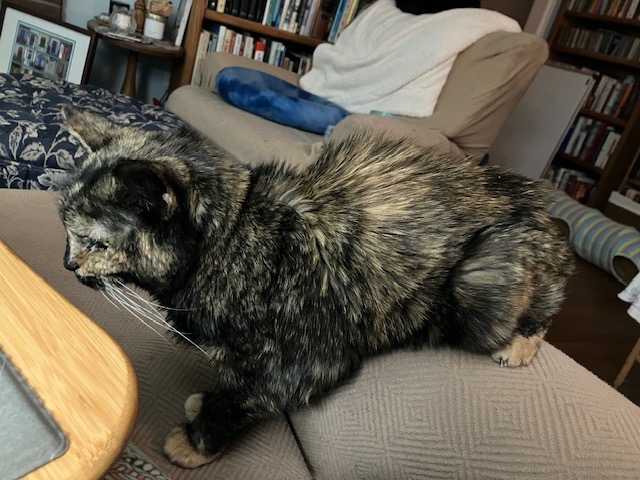
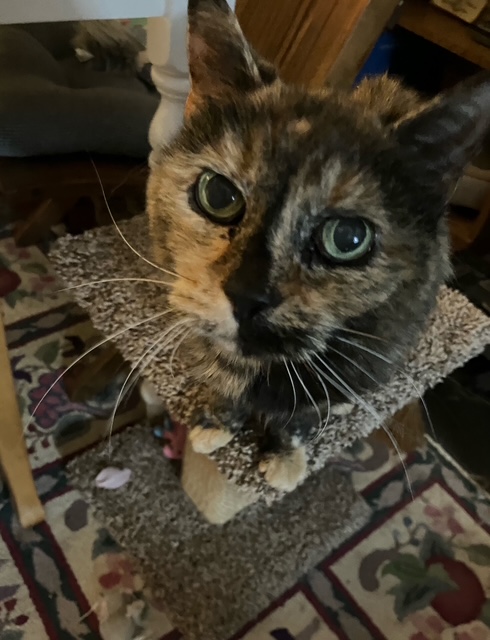
Next week, Olivia will turn eighteen. It feels so unreal. I remember her as a kitten who barely fit in my hand. Now, she’s going to be old enough that if she were human, she could vote.
This must be how parents of human children feel when their offspring drive away and it doesn’t make any sense because just this morning they needed help tying their shoes.
For years, I’ve been listening to Joanna Penn sing the praises of using artificial intelligence [“AI”] to assist in various aspects of the writing and publishing process. Last week, I took the plunge (sort of).
Draft #4 of my current novel is fairly massive. As I worked on Section 3, I found myself wishing I had an outline of all the chapters and scenes to that I could ensure that I wasn’t repeating something I’d written weeks ago and that I wasn’t skipping over something I’d meant to drop in. If I were a best-selling and/or wealthy author who has an assistant, I’d ask my assistant to prepare the outline. As it was, I started an outline a few months ago, and the time it took sketch out just a few scenes made it clear that the task would not only be onerous, but would eat into time I’d rather spend writing.
Maybe it was listening to Joanna’s podcasts about using AI as a tool, but finally, I decided the time had come to be brave. I already had the free version of ChatGPT, so I asked it to outline Section 1 of the book. (The three sections are separate Word documents.) ChatGPT produced summaries of the first two chapters before informing me that I’d exhausted the capacity for the free version and I’d have to wait 24 hours for it to reset.
At this rate, it would take at least three solid weeks to get this outline, and likely longer. Rather than keep coming back every day for another chapter or two, I began researching other AI products to see what else had the capacity to outline a manuscript without being exorbitantly priced. ChatGPT had urged me to upgrade to its $30/month level, but I couldn’t tell how much of the book it would outline even then. I spent a few days trying to decipher AI lingo, including such terms as token and harness, and to sort out the parts I needed to care about.
Last night, I wrapped up Draft #4 of my novel-in-progress. It’s still long—about 15,000 words longer than my other books—and I know it needs tightening. But it’s a substantial improvement on Draft #3, and that counts for a lot.
Writers argue vigorously over the premise that a writer must write every day. Some insist that we must write daily to keep the pump primed. In On Writing, Stephen King said that he tells interviewers that he writes every day except Christmas and his birthday because he thinks that makes him sound normal, but the truth is that he also writes on those days. If you google “must a writer write every day?”, you’ll find dozens of posts defending both the sides of the debate.
The truth, I think, is that you need to do what works for you. If writing every day keeps you in touch with the work, the ideas, the muse—then yes, write every day. If you can maintain your thoughts about the piece even if you skip a day every now and then, take your breaks. If you can—or need to—take weeks or months off after large projects, do what you need to.
Last night as I prepared dinner, I listened to an interview David Marchese of The New York Times did with celebrated author George Saunders.* During the interview, Saunders was talking about his new book, Vigil, as well as other issues such as his personal beliefs. When he was discussing how his childhood Catholicism affects his work, he talked about the experience of writing a character whom he initially disliked and how, as he tried to make the language about the character more interesting, concepts such as liking or dislike the character become “almost useless phrases.” Then, he spoke the words that have stayed in my mind: “Specificity negates judgment.”
In all candor, as I pondered the interview last night, I thought he said a lot more about specificity in writing. It wasn’t until I went back to the printed version of the interview today and searched for “specific” that I discovered this was his only statement on that particular point. But it didn’t matter, because when he said that, he reminded me of something I’ve long known but had somehow managed to forget: good writing is specific.
Think about it. If I tell you a character wore a green shirt, your idea of what that character is wearing may be very different from what I mean. Those words—green and shirt—are so imprecise that without more, your mental image of the character’s appearance will likely be very different from what I intend. Your imagination may clothe the character in a pine-colored button-down corduroy shirt with leather elbow patches and a pocket in which he always keeps a pen, or a short-sleeved blue-green knit polo shirt with a tiny pink polo player stitched onto the left breast, while I meant to dress him in a fluorescent lime-green T-shirt bearing the ghost of a stain from the chili dog he ate two weeks ago. Each of these is indeed a green shirt, yet each speaks very different volumes about the wearer.
General is benign; specific is dynamic. Armed with this reminder, I returned to editing my current book. As I reviewed each scene—each sentence—I sought to oust the general in favor of the specific. For example, a cluster of three interns—a generic, faceless group—became three individuals with distinctive characteristics. They weren’t major characters, so I didn’t devote enormous space to them, but on this pass, I provided enough detail that the first-person narrator (who never learned their names) could easily tell us which was speaking: Glasses, Acne, or the cheerleader. (If the names she assigns them sound a tad judgmental, that reveals something about the narrator.)
I finished this round of edits on the first section of the book last night. Since I only had the revelation about specificity around page 90, I’ll need to go back to the beginning to see what I can tweak in the name of the specific. For now, though, I plan to continue moving forward. In its way, the first section was the easiest, plotwise. I need to gird my loins to address the second and third sections, where character relationships will become more complicated and I’m juggling the unexpected and the inevitable. (No, I will not be more specific at this point.)
But as I edit, the reminder to be more specific will remain with me. Also, as I work with a particular character who would be very easy to judge, I’ll bear in mind George Saunders’ comment that specificity negates judgment. Maybe if I focus on specific aspects of that character, I’ll find that I’m not quite so inclined to judge them. And maybe, if I do this well enough, you won’t judge them, either–and maybe the narrator won’t, either. We’ll see.
I’ve heard people use a lot of words to describe 2025, but as yet, nobody I know has said what a great year it was. Quite the contrary: for people in my world, 2025 well and truly sucked.
Here’s the tally of the losses and challenges among people I know. First, the deaths. Three friends lost their respective fathers. One of those also lost two of her three dogs. My cousin lost two of her sisters in the space of a few weeks. (Yes, they were my cousins, too, but I hadn’t seen or spoken with either in decades.) A volunteer at the cat shelter where I also volunteer died, leaving a 91-year-old husband who couldn’t care for their elderly cats, and so Kallie and Stella are now a part of my family. On the non-death side, a relative got divorced, and a friend lost his job in a way that has required him to hire legal counsel.
As I ruminated on this list, it occurred to me that by comparison, my year went quite well. My immediate family is all in reasonably good health (although my elderly mother did have another mini-stroke early in 2025). In my day job, business was very good. My cat family expanded from four to six, all of whom are doing well despite their exalted ages. While I had to replace the dishwasher and the refrigerator in the space of a few months, I was able to do so. I went on Medicare, which means that I no longer pay health insurance premiums of $1,400 per month. I participated in several excellent markets and book events and was able to chat with a number of people who told me how much they love my books. Although I didn’t finish my current novel-in-progress as I’d originally planned, I have made good progress and I truly believe it will be published this year.
It’s Christmas Eve. All the ordering (and returning and re-ordering) is finished. All the errands—purchasing gifts and cards and wrapping paper and gift bags, all the packing and mailing of gift boxes, all the shopping for holiday meals and parties and events—it’s all done. At least, it’s as done as it’s going to be, because all the stores have closed for Christmas.
Which means that it’s time for a respite. That respite is Jolabokaflod.
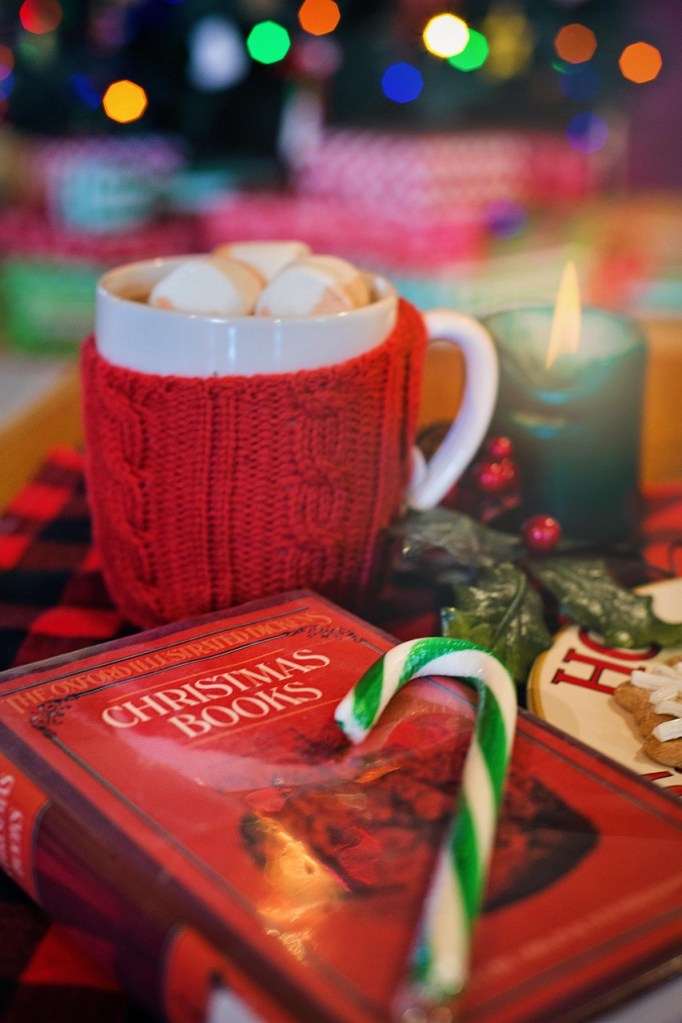
Originating in Iceland, Jolabokaflod translates approximately as “Christmas book flood” or “Yule book flood.” It’s a cozy holiday tradition celebrated on Christmas Eve. For Jolabokaflod, everyone exchanges books as gifts. Then, they spend the evening snuggled up with their new books and hot chocolate or other festive drinks, savoring the peace of the evening and the company of loved ones as they immerse themselves in stories.
It wouldn’t quite be fair to say I wasn’t considering adopting another cat, but I definitely wasn’t considering adopting two.
Turns out, life had other plans.
Ever since Ned’s passing two years ago, I’ve lived with four cats. Some people think this is a lot of cats, but it didn’t seem like a particularly large clowder to me. A few months ago, I considered adopting a diabetic ten-year-old tuxedo cat named Julio. The problem was that Julio is on a very strict diet to manage his diabetes. Since all my cats are grazers, there would be no way to keep him on his diet. So although he’s a lovely boy, I concluded that I wouldn’t be able to take him in.
The next possibility was a five-year-old blind cat named Owen. He’d been dumped in an apartment building parking lot. He was sleek, pewter-gray, and incredibly sweet. I was supposed to be writing his bio, but instead, I decided to adopt him. The next day, as I was completing an adoption application, I received an email advising me that Owen had died earlier that day. Apparently, he’d had an undiagnosed tumor on his spleen, and it burst that morning.
God knows, I wasn’t paying attention. The day before—a Monday in September, bright and sunny—I was in a judge’s chambers in Hartford with an Assistant Attorney General. The lawyer I was working with was on the west coast, and so I’d shown up, and we were discussing the AAG’s claim that the action I’d created—something about a license for someone working in elevators—should be dismissed—for lack of jurisdiction, I think. The judge, whose name I don’t recall, told the AAG—I think his name was Aaron—that he would have to file a written motion to dismiss by Wednesday. The judge—maybe a woman, but I couldn’t say for certain now—told me that I had to get a handful of documents served by then. Sure, fine. Whatever.
The next morning—another bright, sunny September day—I was getting ready to leave when my local public radio station (Remember public radio? Back before the felon cut all the funding?) said something about an airplane having collided with one of the Twin Towers in lower Manhattan. I remembered the Twin Towers, because in 1987, I’d delivered documents there. Don’t recall what documents, to whom, or why, just that I had to drive down from Stamford and whisk up to a triple-digit floor—101? 102? 106? I don’t remember now, because I was more concerned about getting home to continue unpacking, because in the spring of 1987, I was moving to downtown Stamford and an errand to the Twin Towers was unremarkable at best.
But on that September morning—I don’t remember what I thought when I heard about the plane hitting that first tower, except that at the time, I didn’t think much. I went to the lawyer’s office and made copies of the documents that needed to be served. At one point, his bookkeeper said that the radio announcer had said a plane hit the Pentagon, but the bookkeeper thought that was a hoax—no idea why, but that was his opinion.
Tuxedo Cat Press at NoRA Cupcake Company, Middletown, CT
I can picture you squinting, maybe scratching your head: What season?
THE Season.
Football?
Good God, no.
Pumpkin spice?
Nope.
Back to school?
No (and besides, you’re late).
Country fair season?
No, but you’re getting closer.
You mean . . . ?
Yes! It’s Book Event Season!
Um . . . is that even a thing?
It is at my house, baby.
Allow me to explain.
At present, I am looking forward to ten confirmed event days (one fair is two days) where I will be signing and selling books, and more are possible. (See my Upcoming Events pages for details – I have one on my author website and one on Tuxedo Cat Press’s site.) Not bad, considering that (a) there are only fifteen (15) weekends between now and Christmas, (b) I have a full-time day job and various other commitments, and (c) I’d really like to get back to work on my third Claus book.
Even so, I’m looking forward to the Season, and I’d love to have you join me. At outdoor events, I’ll have a tent; at indoor events, a table. Either way, you’ll see the banner for State v. Claus and the sign for Tuxedo Cat Press. As we get closer to the holidays—probably in late October or early November—I’ll be offering free gift-wrapping as well as personalized inscriptions so that you can wrap up your holiday shopping (pun intended) in one stop.
Last Friday, I went outside to clean the moss off my basement steps. There are four steps leading from the yard down to the square of cement in front of my basement door. I can’t recall the last time I cleaned them off. Quite possibly never, if I’m honest. Since I’ve lived here for 26 years, that’s a whole lot of not-cleaning, but they’re just a few steps in my backyard. I’m not even certain whether they’re stone or cement, although they’re perfectly squared off, leading me to suspect they were poured.
A few weeks ago, as I was walking down the steps, I slipped. Just a little, and I didn’t fall. The thought flashed through my brain that I should clean off the moss that covered the steps, but then I moved onto the next thing and forgot all about them. Then, last week, I slipped again. Again, it was just a little bit of slippage, and I didn’t fall, but it occurred to me that if I actually did fall and sustained injury, I’d be on my own. Only a person standing in a certain part of my backyard would ever see me. My neighbors might hear me if I could manage to be loud enough, but if I were to hit my head and be knocked out—more likely that I’d be a late-night snack for one of the bears that is frequenting our neighborhood.





 P. Jo Anne Burgh