Sixty-four days down. Nearly two-thirds of the way to my present goal.
Then what?
(I really need to learn how to recognize an accomplishment without immediately looking beyond it, but that’s for another post.)
What’s truly odd is the extent to which I’m finding myself thrown by Jami Attenberg’s #1000wordsofsummer, which started on Saturday. Somehow, I’d lost track of the days enough that when I received Jami’s first letter on June 1 which encouraged me to write 1,000 words, my first thought was, “Yeah, whatever.” One thousand words a day for fourteen days feels like practically nothing this year, and yet last year, it was a huge deal. The year before—the year my father died during #1000wordsofsummer—I stayed faithful, missing two days and making them up at the end. And yet this year, a part of me feels like, “Fourteen days. So what?”
Most of life involves choices or tradeoffs: if I do A, I can’t also doB. For most of us, these tradeoffs happen so frequently that we barely notice them. After all, making choices and sacrifices is part of being an adult, and we know it. We have to get up for work tomorrow, so we have to go to bed at a reasonable hour. We want to fit into a special outfit, so we order a salad instead of macaroni and cheese. We need to drive home, so we either appoint a designated driver or are very, very careful about our alcohol consumption. (Here in Connecticut, the legal blood alcohol limit will be lowered as of next January, from 0.08% to 0.05%. For some people, this means that having just one drink puts them at risk of being stopped for driving under the influence.)
Today, I made a choice to protect my writing time.
Eventually, I’m going to need to organize the sections of this book. Right now, I’m writing different sections as the mood and ideas dictate. Some sections are barely 1,000 words, while others are much longer. The one I was working on today is now over 22,000 words, and since I know where it’s going, this is the section I’m most likely to pick up tomorrow, and the night after, and probably the night after that.
Fortunately, I have my beloved whiteboard. I am an enormous fan of the whiteboard for mapping out story lines and relationships between characters. Last year, when I was struggling with Becoming Mrs. Claus, I tried to use Scrivener to sort out my various story lines—I even color-coded the scenes—but in the end, it wasn’t for me. In Scrivener, I had dozens of discrete bits and pieces, whereas once I moved it all into a single Word document, I could see where the holes were that needed to be filled. It turned out that my discrete bits and pieces sat in Scrivener like so many marbles, complete in themselves but unrelated to anything else. Once I’d moved everything to Word, I began working on transitions so that one bit would lead logically to the next. Maybe some people can create connective tissue between scenes in Scrivener, but that skill was beyond me.
Can you believe it? I’m halfway to my goal. For 50 days, I’ve written at least 1,000 words per day on my novel—plus whatever blog posts and cat bios I’ve squeezed in. That’s more than 50,000 words in slightly more than a month and a half.
It doesn’t seem real.
Today, I received an email Jami Attenberg mailed in preparation for #1000wordsofsummer. In it, she talked about preparing for the challenge of writing 1,000 words every day for fourteen days. I remember when fourteen days felt like an impossible challenge. Now, it just seems like what you want to do if your goal is to write a book.
I’m closing in on the halfway point of my challenge: Monday will be Day 50 out of 100. The experience feels incredible, and at the same time, it feels strangely effortless.
It’s been a long, long time since I wrote this much. Late in the winter of 2006, when I first rediscovered writing and fan fiction, I dove in. I wrote for hours every night, reveling in the joy of story. I posted my first story in the library of a now-defunct fansite on May 30, 2006, and for the next year, I posted a new story every two weeks. In fact, I spent so much time writing that I fell behind in my billable work and my income dropped significantly. It was like an addiction: I’d be working on a brief, and I’d have a thought about a story in process and I’d open it up, just for a quick look. Two hours later, I’d be no further along on the brief, but the scene I’d edited was much deeper.
I’ve now had this challenge going for 5-1/2 weeks, with nine weeks to go. I’ve blogged about it, but last night, I did something different: for the first time, I called a friend and told her what I was doing.
It could be fairly argued that making that call is no different from telling you, my lovely and supportive blog readers whom I appreciate so much. I think there’s a difference, though. When I write these blog posts, it’s a quick hey, this is what I’m doing. While I’ve known some of you for a very, very long time (looking at you, Kay and Kathleen), most of us haven’t met. It’s unlikely any of you will reach out and hold me accountable. If I drop out of the challenge for some reason, you’re not going to call me and say, “You were doing so well—what happened?” You might wonder why I didn’t make it, but you’re probably not going to text me to ask.
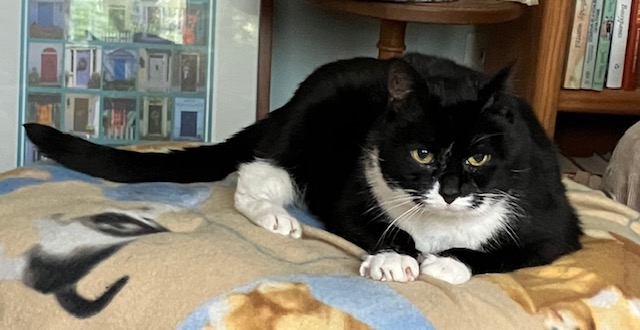
This morning, I slept late and ended up watching church livestreamed on YouTube. After church, I gave into an urge to get back to work on the book. I started a new section that might be the beginning, and then I shifted to another section, developing an entirely different part of the book. Presumably because it wasn’t Official Writing Time, Charlotte declined to join me in the recliner, choosing to nap in her perch instead, Fortunately, Olivia took her place, so I’m pleased to report that Tuxedo Cat Press has continued to provide appropriate supervision as I perform this challenge.
Oliva, Editor-in-Chief of Tuxedo Cat Press
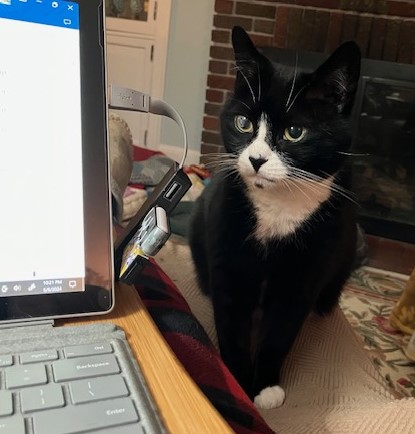
But as it turns out, Charlotte isn’t the only creature of habit. I returned from Mom’s just before nine o’clock this evening. As I puttered around, doing various house chores, I had the familiar urge to write—after all, Official Writing Time was fast approaching. So even though I’d already written my 1,000 words, I settled back into the routine. Sure enough, this time Charlotte joined me.
Charlotte, Managing Editor of Tuxedo Cat Press
One of the things about the challenge that I’m enjoying is the fact that what I write doesn’t have to be gorgeous, polished prose. It’s enough simply to tell a story. If I use the word “really” in the space of two sentences, the world won’t end, because I can fix it when I edit. At this stage of the proceedings, all I need to do is to explore what my characters think and feel as they converse and act. Turns out, there’s a huge freedom to be found in discovering a story one smallish chunk at a time. Eventually, I’ll need to look at the whole piece, identify the gaps, and write the missing material, but that time is yet to come.
Right now, it’s almost scary how smoothly the story is moving. After my struggles with Becoming Mrs. Claus, it’s hard to believe the way this story is flowing. While I don’t believe in jinxes, there’s a part of me that’s hissing, “You fool! Don’t publish a statement like that!” for fear that one day, I’ll sit down to write and nothing will come. I almost didn’t write this evening for precisely the same reason, i.e., a fear of “using up” the story. It’s as though I don’t trust that as long as I keep showing up and writing, my brain or the muse or whatever my source is will continue to deliver story material.
But writing is an act of faith, always has been. The faith that somehow, in the thousands upon thousands* of words in the English language, I will recall or find the words that best express what I’m thinking so that I can communicate that thought to someone else. The faith that those words will create a world so vivid that a complete stranger can enter it. The faith that from those words will spring characters no one has ever before conjured and that somehow, the lives of those fictional people will touch a reader’s heart.
And so, I will not be afraid of double-shot days. Because I have faith in the words.
*Fun fact: the Second Edition of the 20-volume Oxford English Dictionary contains full entries for 171,476 words in current use, plus 47,156 obsolete words.
We’ve all heard of setting ourselves up to fail. It’s what happens when we’re gung-ho about doing something right now even though any remotely rational person would say, “Um, honey? Maybe this isn’t exactly the right time.” Continue reading →









 P. Jo Anne Burgh