For years, I’ve been listening to Joanna Penn sing the praises of using artificial intelligence [“AI”] to assist in various aspects of the writing and publishing process. Last week, I took the plunge (sort of).
Draft #4 of my current novel is fairly massive. As I worked on Section 3, I found myself wishing I had an outline of all the chapters and scenes to that I could ensure that I wasn’t repeating something I’d written weeks ago and that I wasn’t skipping over something I’d meant to drop in. If I were a best-selling and/or wealthy author who has an assistant, I’d ask my assistant to prepare the outline. As it was, I started an outline a few months ago, and the time it took sketch out just a few scenes made it clear that the task would not only be onerous, but would eat into time I’d rather spend writing.
Maybe it was listening to Joanna’s podcasts about using AI as a tool, but finally, I decided the time had come to be brave. I already had the free version of ChatGPT, so I asked it to outline Section 1 of the book. (The three sections are separate Word documents.) ChatGPT produced summaries of the first two chapters before informing me that I’d exhausted the capacity for the free version and I’d have to wait 24 hours for it to reset.
At this rate, it would take at least three solid weeks to get this outline, and likely longer. Rather than keep coming back every day for another chapter or two, I began researching other AI products to see what else had the capacity to outline a manuscript without being exorbitantly priced. ChatGPT had urged me to upgrade to its $30/month level, but I couldn’t tell how much of the book it would outline even then. I spent a few days trying to decipher AI lingo, including such terms as token and harness, and to sort out the parts I needed to care about.
Last night as I prepared dinner, I listened to an interview David Marchese of The New York Times did with celebrated author George Saunders.* During the interview, Saunders was talking about his new book, Vigil, as well as other issues such as his personal beliefs. When he was discussing how his childhood Catholicism affects his work, he talked about the experience of writing a character whom he initially disliked and how, as he tried to make the language about the character more interesting, concepts such as liking or dislike the character become “almost useless phrases.” Then, he spoke the words that have stayed in my mind: “Specificity negates judgment.”
In all candor, as I pondered the interview last night, I thought he said a lot more about specificity in writing. It wasn’t until I went back to the printed version of the interview today and searched for “specific” that I discovered this was his only statement on that particular point. But it didn’t matter, because when he said that, he reminded me of something I’ve long known but had somehow managed to forget: good writing is specific.
Think about it. If I tell you a character wore a green shirt, your idea of what that character is wearing may be very different from what I mean. Those words—green and shirt—are so imprecise that without more, your mental image of the character’s appearance will likely be very different from what I intend. Your imagination may clothe the character in a pine-colored button-down corduroy shirt with leather elbow patches and a pocket in which he always keeps a pen, or a short-sleeved blue-green knit polo shirt with a tiny pink polo player stitched onto the left breast, while I meant to dress him in a fluorescent lime-green T-shirt bearing the ghost of a stain from the chili dog he ate two weeks ago. Each of these is indeed a green shirt, yet each speaks very different volumes about the wearer.
General is benign; specific is dynamic. Armed with this reminder, I returned to editing my current book. As I reviewed each scene—each sentence—I sought to oust the general in favor of the specific. For example, a cluster of three interns—a generic, faceless group—became three individuals with distinctive characteristics. They weren’t major characters, so I didn’t devote enormous space to them, but on this pass, I provided enough detail that the first-person narrator (who never learned their names) could easily tell us which was speaking: Glasses, Acne, or the cheerleader. (If the names she assigns them sound a tad judgmental, that reveals something about the narrator.)
I finished this round of edits on the first section of the book last night. Since I only had the revelation about specificity around page 90, I’ll need to go back to the beginning to see what I can tweak in the name of the specific. For now, though, I plan to continue moving forward. In its way, the first section was the easiest, plotwise. I need to gird my loins to address the second and third sections, where character relationships will become more complicated and I’m juggling the unexpected and the inevitable. (No, I will not be more specific at this point.)
But as I edit, the reminder to be more specific will remain with me. Also, as I work with a particular character who would be very easy to judge, I’ll bear in mind George Saunders’ comment that specificity negates judgment. Maybe if I focus on specific aspects of that character, I’ll find that I’m not quite so inclined to judge them. And maybe, if I do this well enough, you won’t judge them, either–and maybe the narrator won’t, either. We’ll see.
Tuxedo Cat Press at NoRA Cupcake Company, Middletown, CT
I can picture you squinting, maybe scratching your head: What season?
THE Season.
Football?
Good God, no.
Pumpkin spice?
Nope.
Back to school?
No (and besides, you’re late).
Country fair season?
No, but you’re getting closer.
You mean . . . ?
Yes! It’s Book Event Season!
Um . . . is that even a thing?
It is at my house, baby.
Allow me to explain.
At present, I am looking forward to ten confirmed event days (one fair is two days) where I will be signing and selling books, and more are possible. (See my Upcoming Events pages for details – I have one on my author website and one on Tuxedo Cat Press’s site.) Not bad, considering that (a) there are only fifteen (15) weekends between now and Christmas, (b) I have a full-time day job and various other commitments, and (c) I’d really like to get back to work on my third Claus book.
Even so, I’m looking forward to the Season, and I’d love to have you join me. At outdoor events, I’ll have a tent; at indoor events, a table. Either way, you’ll see the banner for State v. Claus and the sign for Tuxedo Cat Press. As we get closer to the holidays—probably in late October or early November—I’ll be offering free gift-wrapping as well as personalized inscriptions so that you can wrap up your holiday shopping (pun intended) in one stop.
Last Friday, I went outside to clean the moss off my basement steps. There are four steps leading from the yard down to the square of cement in front of my basement door. I can’t recall the last time I cleaned them off. Quite possibly never, if I’m honest. Since I’ve lived here for 26 years, that’s a whole lot of not-cleaning, but they’re just a few steps in my backyard. I’m not even certain whether they’re stone or cement, although they’re perfectly squared off, leading me to suspect they were poured.
A few weeks ago, as I was walking down the steps, I slipped. Just a little, and I didn’t fall. The thought flashed through my brain that I should clean off the moss that covered the steps, but then I moved onto the next thing and forgot all about them. Then, last week, I slipped again. Again, it was just a little bit of slippage, and I didn’t fall, but it occurred to me that if I actually did fall and sustained injury, I’d be on my own. Only a person standing in a certain part of my backyard would ever see me. My neighbors might hear me if I could manage to be loud enough, but if I were to hit my head and be knocked out—more likely that I’d be a late-night snack for one of the bears that is frequenting our neighborhood.
I nearly had a break today. I came thisclose to taking off the most beautiful day in ages, the kind the weather people call a “top ten weather day.” The heat wave broke, the sky was vivid blue with feathery white clouds, the temperatures were mild, and I had no deadlines looming.
Or so I thought.
Turns out, I’d forgotten about one. I only remembered because the client called around noon to ask about the project. And just like that, my day off was shot to hell.
I’ve lost track of the count. While I’ve been making notes and thinking over the past two days, the only writing I’ve done (other than legal work) has been a couple scribbled notes. (I nearly wrote “a few,” but the truth is there are only two, one yesterday and one today. If I’m going to confess, I may as well be honest.)
At first, if I missed a day, I circled it on the calendar. Then, I found I was forgetting to cross off days, and I had to try to remember whether it was because I’d written and not noted it or if I’d simply not written. Either way, it wasn’t terrific. At this point, I could make a decent guess about how many days I’ve missed—ten, maybe. Not brilliant, but at least I’ve plodded along.
The upside is that by pushing myself in the past two months, I’ve made very good progress on the section of the book that really, really needed work—as in, it wasn’t there. All I had was a note that I had to add a climax and a conclusion. Those are pretty big things to need to add.
My problem was that I hadn’t figured out what they were going to be, apart from a vague notion about something at the very end. I’d also forgotten the most important thing about my process, which is that I write to discover the story. When I started following the characters instead of dictating to them, the final ascent to the climax began to unfold. (Yes, I’m mixing the hell out of my metaphors. Enjoy.)
Come on, admit it. You figured I threw in the towel, especially since my last blog post had nothing to do with this project.
Well, maybe. I mean, it’s been a while.
I’ll admit, I’ve missed two days (which is why this was Day 52, not Day 54). And some of my writing days have been fairly minimal—half an hour (or less), or just research, or mainly reading and editing. It’s certainly been no #1000wordsofsummer this year.
But that’s actually a good thing.
Sure, right.
No, really, I’m not making excuses. For where this book is now, a daily word goal would have been counterproductive. Word goals are good when you’re putting down the first draft and figuring out the story. That’s not where I am now. At this point, I’m fleshing out a piece of the story that I’d found wildly intimidating. By going slowly and including research, I’m making real progress, not just slap down some words and call it done progress. I’m cutting phrases and lines and paragraphs and whatever else needs to go. I’m editing what was already there to accommodate the new material. I’m seeing how the new stuff is going to impact what came before, such as where I need to drop in references so that what happens in the climactic section isn’t coming out of the blue. (I hate it when I get broadsided by critical information just at the pivotal moment. It’s like reading a murder mystery and being told on page 332 of a 335-page book that the main suspect had a twin brother nobody knew about, and the two planned the murder together, with one of them accepting an award at a black-tie event—perfect alibi—while the other committed the murder.)
The reality is that barring a flat-out miracle—including three months when I don’t have to practice law and yet money magically appears in the bank every month, as well as a brilliant (and affordable) editor who is free to drop everything and spend four weeks helping me turn this mess into a masterpiece—there is simply no way this book will be out for the holidays this year. I hate that so much. At book events last year, I kept telling people that the new book would be out this year. Now, I’m making myself a liar. The only option would be to write and publish a novella-length piece in this series, except that there isn’t time to do that because I’d have to start from scratch and it’s already the middle of June and I have no ideas for something short and self-contained. I can’t even use the first section of the present book, because there’s nothing particularly Christmasy about it, and if I’m going to publish a novella about Santa Claus at the holidays, it needs to be Christmasy. Plus, because I’m me and I require everything to fit together, it would somehow need to advance the series.
Sigh.
You’re probably wishing right now that this was another post about ecclesiastical garments. Mea maxima culpa.
Except . . . you know. . . .
No. Absolutely not. It wouldn’t work.
Well, maybe. . . .
Forget it. I’m sticking with the manuscript in progress.
But what if. . . ?
This is ridiculous. I can’t get distracted. Not now. I cannot go from start to finish on another book–especially not in time for the holidays. It is not possible. It doesn’t matter that there’s this one large, gaping hole in the narrative, and there isn’t room in this book to deal with that issue because it would make the book much longer and it doesn’t fit anywhere with any of the rest of the story anyway, so it would have to be separate anyway except that it wouldn’t be long enough to be a novel by itself, so. . . .
I’m just saying. . . .
Oh, shut up.
Photo credit: fr0ggy5 on Unsplash
Well. I certainly didn’t see this coming when I started this post. And I don’t know whether it’ll be possible anyway.
But it would address that gaping hole, which is nice because the book I’m currently working on is the final book of the series, so this would take care of that issue before I get to the finale. Not that anybody has ever mentioned the hole. Maybe I’m the only one who sees it. Maybe it’s not really a hole at all.
I hate moving away from the book in progress now, just when I’m finally getting a firm handle on it. After all, do I really have to have a new book this year? Of course not. Nobody’s going to cry if I tell them it’s not happening this year. Most of the people from last year’s events probably won’t remember anyway. It’s not as if they’re sitting around saying, “Oh, I can’t wait for [fill in the event], because P. Jo Anne Burgh said she’s going to have a new book this year!”
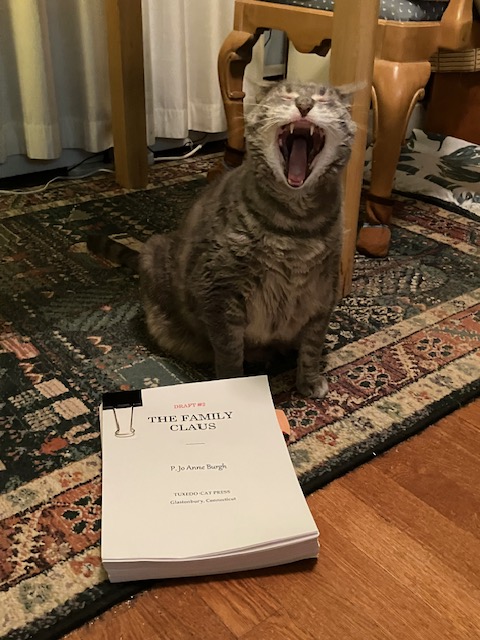
Danny is very excited that there’s finally a printed draft.
It’s been two weeks since I posted an update.
(You thought I quit, didn’t you?)
I wasn’t going to quit, but I did come perilously close to a . . . hiatus . . . over the past several days. It’s the kind of thing that can happen when the Day Job takes over your days (and nights) for weeks on end, including weekends. I know work will slow as we move into summer because after 28 years, I recognize that this is how things roll, so I know to be grateful for the current hectic pace. Still, I’m exhausted, and there comes a point where too many things demand your attention, and you say, “Fine, whatever. I’ll get back to the book when I get a chance.”
Caveat for all the writers who really want to write someday, but who believe can’t write unless they feel inspired: you may not want to read this post.
(If you’re still reading, don’t say I didn’t warn you.)
Working on this book for thirteen days straight has reminded me of a truth I’d forgotten: a proven* way to become inspired to write is to start writing, and then keep writing.
You read that correctly. Instead of waiting for the inspiration before you start writing, take whatever weird little nugget of a thought you have, and start writing about that. If the weird little nugget is, “I forgot to buy mustard,” start writing about a person who goes to the supermarket or the corner bodega or the general store or the gourmet shop or Costco—in other words, anywhere you can go to purchase mustard—and follow them around the store to find out why they forgot the mustard. Did they leave the list at home? If so, why? Were they distracted when they were getting ready to leave the house and they left the list on the kitchen counter? Or are they accustomed to chatting on the phone with their spouse or significant other or parent while shopping and that person tells them what to get, only this time, that person is unavailable for a specific reason—out of town, had a fight, died, just separated, is working and can’t be disturbed, is trying to get the baby to sleep, is running a marathon—so the shopper is on their own. Or maybe there’s some hostility attached to the mustard, such as how they only need it because Rachel is bringing her new boyfriend Kyle when the group goes on a beach picnic and the shopper is in charge of the sandwiches, and nobody likes Kyle because he’s so judgy, and he claims he can only eat this certain brand of mustard, so the shopper subconsciously doesn’t want to buy it, especially since with any luck, Rachel will dump him before the next picnic and nobody else likes that brand.
All those possibilities out of something as mundane as “I forgot to buy mustard.”
That’s it. That’s my logic. That’s why last Wednesday, I started another 100-day project. Because I’ve been stalled on my novel for way too long, and I’m hoping this will work.
I’ve already given myself permission to fail, sort of. After telling people last year that the new Claus book would be out for the holidays, I’ve given myself permission not to be done on time. I’ll be apologizing all over the place, and sales will likely be in the toilet, but I’m not going to push just to get a book out the door by an arbitrary, self-imposed deadline and have the book be lousy.







 P. Jo Anne Burgh