Come on, admit it. You figured I threw in the towel, especially since my last blog post had nothing to do with this project.
Well, maybe. I mean, it’s been a while.
I’ll admit, I’ve missed two days (which is why this was Day 52, not Day 54). And some of my writing days have been fairly minimal—half an hour (or less), or just research, or mainly reading and editing. It’s certainly been no #1000wordsofsummer this year.
But that’s actually a good thing.
Sure, right.
No, really, I’m not making excuses. For where this book is now, a daily word goal would have been counterproductive. Word goals are good when you’re putting down the first draft and figuring out the story. That’s not where I am now. At this point, I’m fleshing out a piece of the story that I’d found wildly intimidating. By going slowly and including research, I’m making real progress, not just slap down some words and call it done progress. I’m cutting phrases and lines and paragraphs and whatever else needs to go. I’m editing what was already there to accommodate the new material. I’m seeing how the new stuff is going to impact what came before, such as where I need to drop in references so that what happens in the climactic section isn’t coming out of the blue. (I hate it when I get broadsided by critical information just at the pivotal moment. It’s like reading a murder mystery and being told on page 332 of a 335-page book that the main suspect had a twin brother nobody knew about, and the two planned the murder together, with one of them accepting an award at a black-tie event—perfect alibi—while the other committed the murder.)
The reality is that barring a flat-out miracle—including three months when I don’t have to practice law and yet money magically appears in the bank every month, as well as a brilliant (and affordable) editor who is free to drop everything and spend four weeks helping me turn this mess into a masterpiece—there is simply no way this book will be out for the holidays this year. I hate that so much. At book events last year, I kept telling people that the new book would be out this year. Now, I’m making myself a liar. The only option would be to write and publish a novella-length piece in this series, except that there isn’t time to do that because I’d have to start from scratch and it’s already the middle of June and I have no ideas for something short and self-contained. I can’t even use the first section of the present book, because there’s nothing particularly Christmasy about it, and if I’m going to publish a novella about Santa Claus at the holidays, it needs to be Christmasy. Plus, because I’m me and I require everything to fit together, it would somehow need to advance the series.
Sigh.
You’re probably wishing right now that this was another post about ecclesiastical garments. Mea maxima culpa.
Except . . . you know. . . .
No. Absolutely not. It wouldn’t work.
Well, maybe. . . .
Forget it. I’m sticking with the manuscript in progress.
But what if. . . ?
This is ridiculous. I can’t get distracted. Not now. I cannot go from start to finish on another book–especially not in time for the holidays. It is not possible. It doesn’t matter that there’s this one large, gaping hole in the narrative, and there isn’t room in this book to deal with that issue because it would make the book much longer and it doesn’t fit anywhere with any of the rest of the story anyway, so it would have to be separate anyway except that it wouldn’t be long enough to be a novel by itself, so. . . .
I’m just saying. . . .
Oh, shut up.
Photo credit: fr0ggy5 on Unsplash
Well. I certainly didn’t see this coming when I started this post. And I don’t know whether it’ll be possible anyway.
But it would address that gaping hole, which is nice because the book I’m currently working on is the final book of the series, so this would take care of that issue before I get to the finale. Not that anybody has ever mentioned the hole. Maybe I’m the only one who sees it. Maybe it’s not really a hole at all.
I hate moving away from the book in progress now, just when I’m finally getting a firm handle on it. After all, do I really have to have a new book this year? Of course not. Nobody’s going to cry if I tell them it’s not happening this year. Most of the people from last year’s events probably won’t remember anyway. It’s not as if they’re sitting around saying, “Oh, I can’t wait for [fill in the event], because P. Jo Anne Burgh said she’s going to have a new book this year!”
Yesterday, I was distracted during the proclamation of the gospel. At risk of being sacrilegious, I confess that instead of listening to the words that were read, I contemplated textiles and seamstresses.
Allow me to explain.
The way things are arranged at my church is likely the same as at many Episcopal churches. We generally have two priests at a service. One of them preaches, and the other is the celebrant, meaning that their main job is to celebrate communion. Other participants include the organist/choir director, the choir, the acolytes, and the lay reader. It’s a nice division of labor.
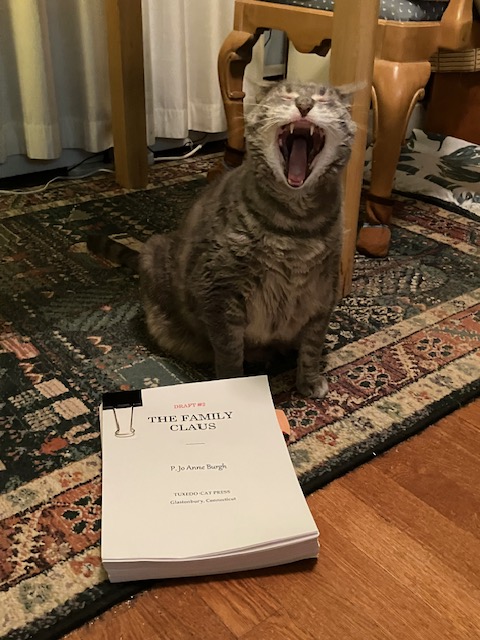
Danny is very excited that there’s finally a printed draft.
It’s been two weeks since I posted an update.
(You thought I quit, didn’t you?)
I wasn’t going to quit, but I did come perilously close to a . . . hiatus . . . over the past several days. It’s the kind of thing that can happen when the Day Job takes over your days (and nights) for weeks on end, including weekends. I know work will slow as we move into summer because after 28 years, I recognize that this is how things roll, so I know to be grateful for the current hectic pace. Still, I’m exhausted, and there comes a point where too many things demand your attention, and you say, “Fine, whatever. I’ll get back to the book when I get a chance.”
Caveat for all the writers who really want to write someday, but who believe can’t write unless they feel inspired: you may not want to read this post.
(If you’re still reading, don’t say I didn’t warn you.)
Working on this book for thirteen days straight has reminded me of a truth I’d forgotten: a proven* way to become inspired to write is to start writing, and then keep writing.
You read that correctly. Instead of waiting for the inspiration before you start writing, take whatever weird little nugget of a thought you have, and start writing about that. If the weird little nugget is, “I forgot to buy mustard,” start writing about a person who goes to the supermarket or the corner bodega or the general store or the gourmet shop or Costco—in other words, anywhere you can go to purchase mustard—and follow them around the store to find out why they forgot the mustard. Did they leave the list at home? If so, why? Were they distracted when they were getting ready to leave the house and they left the list on the kitchen counter? Or are they accustomed to chatting on the phone with their spouse or significant other or parent while shopping and that person tells them what to get, only this time, that person is unavailable for a specific reason—out of town, had a fight, died, just separated, is working and can’t be disturbed, is trying to get the baby to sleep, is running a marathon—so the shopper is on their own. Or maybe there’s some hostility attached to the mustard, such as how they only need it because Rachel is bringing her new boyfriend Kyle when the group goes on a beach picnic and the shopper is in charge of the sandwiches, and nobody likes Kyle because he’s so judgy, and he claims he can only eat this certain brand of mustard, so the shopper subconsciously doesn’t want to buy it, especially since with any luck, Rachel will dump him before the next picnic and nobody else likes that brand.
All those possibilities out of something as mundane as “I forgot to buy mustard.”
That’s it. That’s my logic. That’s why last Wednesday, I started another 100-day project. Because I’ve been stalled on my novel for way too long, and I’m hoping this will work.
I’ve already given myself permission to fail, sort of. After telling people last year that the new Claus book would be out for the holidays, I’ve given myself permission not to be done on time. I’ll be apologizing all over the place, and sales will likely be in the toilet, but I’m not going to push just to get a book out the door by an arbitrary, self-imposed deadline and have the book be lousy.
In the summer of 1997, I clipped a comic strip from the newspaper. The strip was “B.C.,” then drawn by Johnny Hart. The characters in the strip were cavemen, and the themes regularly invoked Mr. Hart’s religious views. The one I carry was part of an ongoing story where one of the cavemen was floating on a tiny raft with a crab. The raft was barely large enough to hold the caveman, the post with a sail, and a box against which the caveman was resting his head. The crab was in a crow’s nest that looked like a flowerpot mounted atop the pole. In the first panel, the caveman wants to know whether there’s any land in sight, and the crab, showing optimism, says, “Not yet.” Then the caveman complains about how the crab is no good and how he (the caveman) is starving to death. The crab reprimands him and in the final frame, it says, “Have hope—provision will come.” The caveman demands, “. . . And just who is going to provide?” Then, as a fish jumps from the water into the box, a voice from above proclaims “I AM.”
I’ve carried this clipping in my day planner for nearly twenty-eight years. During the inevitable lean times in the life of a freelancer, the strip has reminded me that provision will indeed come. And it always has, ever since the end of May, 1997, when I left a full-time job with a regular salary, paid time off, health insurance, and employer contributions (albeit minimal) to my retirement account. I had one client, a box of business cards, and a book entitled, Money-Smart Secrets for the Self-Employed, by Linda Stern.
Sooner or later, every author hears the question: “What is your book about?” Usually, this is the point where we launch into our elevator pitch. (For those of you who aren’t familiar with the term, an elevator pitch is a very short sales pitch for your book, so named because you should be able to rattle it off in the time it takes the elevator to get to the other person’s floor.)
But when you’re working on the book, this question isn’t about sales. Rather, it’s closer to, “What is the theme of your book?” Or not even the theme, but just the general topic. For example, before I’d honed my elevator pitch for State v. Claus, I used to tell people the book was about belief. Needless to say, this vague answer didn’t sell a lot of books, but for me, it was the light shining from the lighthouse as I struggled to craft the story. What do people believe? Why do they believe? Is belief a choice, or is it just what happens? What would you believe if it might cost you everything?
For Becoming Mrs. Claus, the theme was choices. Good choices, bad choices, downright stupid choices. Making choices, or trying not to. Dealing with the fallout from poor choices. Again, a general recognition of this helped me to navigate as I plotted the story. I’m not saying it governed every decision, but the idea hung out in the background as the characters went about their days.
With my as-yet-unnamed novel (working title: Claus 3), I wrote for a long time without knowing the theme. I knew what was happening, and I had the foggiest idea how the bits hung together, but I didn’t know why I was writing about these things. To be fair, certain questions had come up while I was writing Becoming Mrs. Claus, but I ended up deleting that material because it didn’t tie well into the central theme. Plus, it would have made the book at least 30,000 words longer, and that’s a really big detour to toss in. So when I was casting about for an idea for my next book after Becoming Mrs. Claus, it occurred to me to revisit some of the material I’d excised from that book. After all, it would be so much easier to write the next book if I already had lots of material, right? All I’d have to do was to fill in a few gaps, and voilà! Instant novel! Sort of like adding water to a cup of ramen noodles and having lunch.
It sounded good, anyway.
Photo credit: Piotr Miazga
Instead, I wrote without knowing how the various pieces hung together. I did my 100K-word challenge last year, convinced that the story would fall into place and all my questions would answer themselves. It’s amazing how naïve a person can still be about process when she’s working on her third novel. But even with more than 100K words in the bank, I still didn’t know exactly what the story was about, not really. When you think about it, that’s sort of remarkable.
So I did the reasonable thing, which was to let the manuscript sit. Not a day went by that I wasn’t kicking ideas around in my head, but I seldom opened my computer. I made notes in my purple notebook, but few of them moved into the document. Then, fall came, and with it the Season of Selling. My focus shifted from creating to marketing, including hauling bins and tables to holiday markets every week. It didn’t help that Thanksgiving was late and the holiday season was short: starting with the Saturday after Thanksgiving, I had four events in eight days. The next weekend, I was supposed to have two more, but I succumbed to a nasty bronchial virus that laid me out flat and required me to cancel the remainder of the season.
As I coughed my brains out, it occurred to me that I’d been telling people for weeks that Claus 3 would be out for the holidays in 2025, and yet I still didn’t have a full first draft. This was troublesome, to say the least. On the upside, I had identified one massive problem with second part of the manuscript. So I began to rewrite that second part. I changed the setting, eliminated unnecessary characters, and tightened the plot. While it still needs editing, remedying that problem went a long way toward a completed draft for two reasons. The first, of course, was that I fixed a huge plot problem. But the second was even better: I figured out what the book is about.
Turns out, Claus 3 is about family.
And that’s where you, as my blog readers, come in.
Family is an enormously complicated topic. We think we know what a family looks like, but it turns out that “family” is a slippery little sucker that defies definition. For example, this evening when I had dinner with my mother, who is ninety and conservative, I asked her what a family looks like to her. She thought for a second before saying, “A man and a woman and two children.”
Thing is, she and Dad had three children, my two sisters and me. Plus, she was the youngest of four children born to my grandparents, in whose house also lived Aunt Florence, who never married, and her brother, George, whom she cared for because he was developmentally disabled. By Mom’s definition, neither our immediate family nor her family of origin were families.
So I pressed on, and she broadened her definition to include someone who always stands up for you, whom you can count on, who will be there for you, who will go to the hospital with you. (Two weeks ago, I took her to the emergency room after a fall, so this was apparently on her mind.) I asked if she thought my nephew and his significant other were a family; they’ve been together for eight years and are, by their own description, “as committed as you can be without involving God or the state.” She considered this, deciding that “I guess they think they are,” which presented another wrinkle: who decides whether a particular group is a family? Is it up to the individuals involved, or can someone outside that group proclaim that they are or are not a family?
Some families are created by legally recognized actions, such as marriage or adoption, while others must continually fight to be recognized as families. Ten years ago, the city of Hartford found itself faced with this question in the case involving the group known as the “Scarborough 11.” This group, consisting eight adults and three children, sought to buy a large home together on Scarborough Street, a prestigious neighborhood of single-family homes in Hartford’s West End. Some of the neighbors objected on the grounds that this group was not, could not be, a family, and the city brought suit to require them to vacate the property, while the group insisted that they were an “intentional family” and entitled to remain. Ultimately, the city abandoned its lawsuit; however, the question of whether the Scarborough 11 were a family (there are now only ten of them, one adult having departed the group) has not, to my knowledge, been resolved. (Whether a new attack is brought in reliance on the current political climate remains to be seen.)
In the introduction to her book of essays, More Home Cooking, the late great Laurie Colwin talked about blood relatives and “family by choice” as she discussed the idea of a family meal. Elsewhere, I’ve heard the term “family by chance” to describe those to whom we are linked by genetics rather than by an affirmative decision on someone’s part. Interestingly, marriages are, by definition, the creation of a family by choice. Two people who have no legal relationship choose to create a legal bond. Of course, there are those who argue that the couple alone cannot be a family; to them, there is no “family” until at least one child joins the mix. But is this a valid proposition? Are two married people a family? Are people still family after a divorce, or does that sever the family bond? What if they have a child together, but they go on to marry or commit to other people—is the entire group a family?
In Grey’s Anatomy, two of the characters, Meredith and Cristina, become very close friends. In the first season, Cristina is pregnant and plans to terminate the pregnancy. She tells Meredith that she put her down as her emergency contact person. In a line which has become resonant, she says, “I put you down. . . . You’re my person.” Neither woman is sentimental, but “you’re my person” becomes another way of saying, “You’re my family.” One article described it this way: “It’s someone who understands what you’re thinking or feeling, no explanation required.”
And then we have the blended families, which many of us recall from the days of The Brady Bunch, when Mike Brady, who had three sons, married Carol, who had three daughters. In an early episode, the youngest son struggled with the notion of Carol as a stepmother. Toward the end, I recall Carol pointing to the staircase and saying, “The only steps in this house are those,” meaning that they were all family. At the time, it seemed quite tidy; now, I wonder what those kids were supposed to think about their late parents, as well as any relatives they might have had through that parent. Were the parents of the girls’ late father no longer their grandparents? Was the brother of the boys’ late mother no longer their uncle?
All of this is designed to give you some food for thought on the issue, because I’m asking for a favor: if you’re willing, I’d like for you to tell me in the comments what you think the attributes of a family are. What are the essentials? Must there be a legal connection, such as a marriage or an adoption? Must the connection be intended to be permanent, or would a foster relationship qualify? Must there be a sexual component as between (at least) two of the adult members, or can people form a family who do not have a sexual relationship?
To be clear: I’m not interested in a political discussion. I simply want input from people about how they, as individuals, view the concept of family.
You don’t have to write a treatise; one or two lines are fine. Since this is a public forum, it’s probably still best if you use pseudonyms or initials if you want to refer to real people who aren’t public figures. (Changing identifying details would also be an excellent idea.) Also, please indicate whether it’s okay with you if I thank you by name in the acknowledgement section of this book.
To say that many of us have been dreading 2025 is an understatement. In the United States, the prospect of a felon taking the highest office and filling important positions with ignorant lackeys is beyond grim. The expected effect of this incompetent regime on our democracy is nothing short of terrifying. The days of intelligence, competence, and decency—not to mention the rule of law—seem to be nearly at an end.
Even before we reach this nadir, horribleness surrounds us. Barely a few hours into the new year, a motorist drove at high speed into a crowd in New Orleans, killing fifteen people and injuring dozens more. In Honolulu, a fireworks accident just before midnight killed at least three people and injured twenty. Still another person died when a cybertruck exploded in Las Vegas. And around the world, other governments seem to be descending into their own pit of chaos.
Liminal is a word for the in-between. It describes states, times, spaces, etc., that exist at a point of change—a metaphorical threshold. . . . something that is barely perceptible or barely capable of eliciting a response.
These days between Christmas and New Year’s Day are liminal. Quiet, with few demands made. When an email is sent or a phone call is made, there is little expectation of a reply until after January 1. Practically no one schedules appointments or events unless they have previously confirmed that the other party will be around and available. We exist in a state of near-invisibility, anticipating a muted response to any inquiry, as if everyone is half-asleep.
Adding to this illusion today is the grayness, the wetness, the fog hovering near the ground that just yesterday was covered in snow and is now a soggy brown with hints of dead grass. A book I read as a child included a line that has remained with me: “New England, as usual, has gone white for the winter, and it will be many weeks before we see the earth again.”[1] Sadly, New England—at least, southern New England—no longer goes white for the winter. Our so-called winters are now little more than strings of rainy gray days, occasionally punctuated by squalls that leave heavy, wet snow/slush combinations to be scraped away before they turn into puddles topped with papery layers of ice like an inferior crème brûlée.
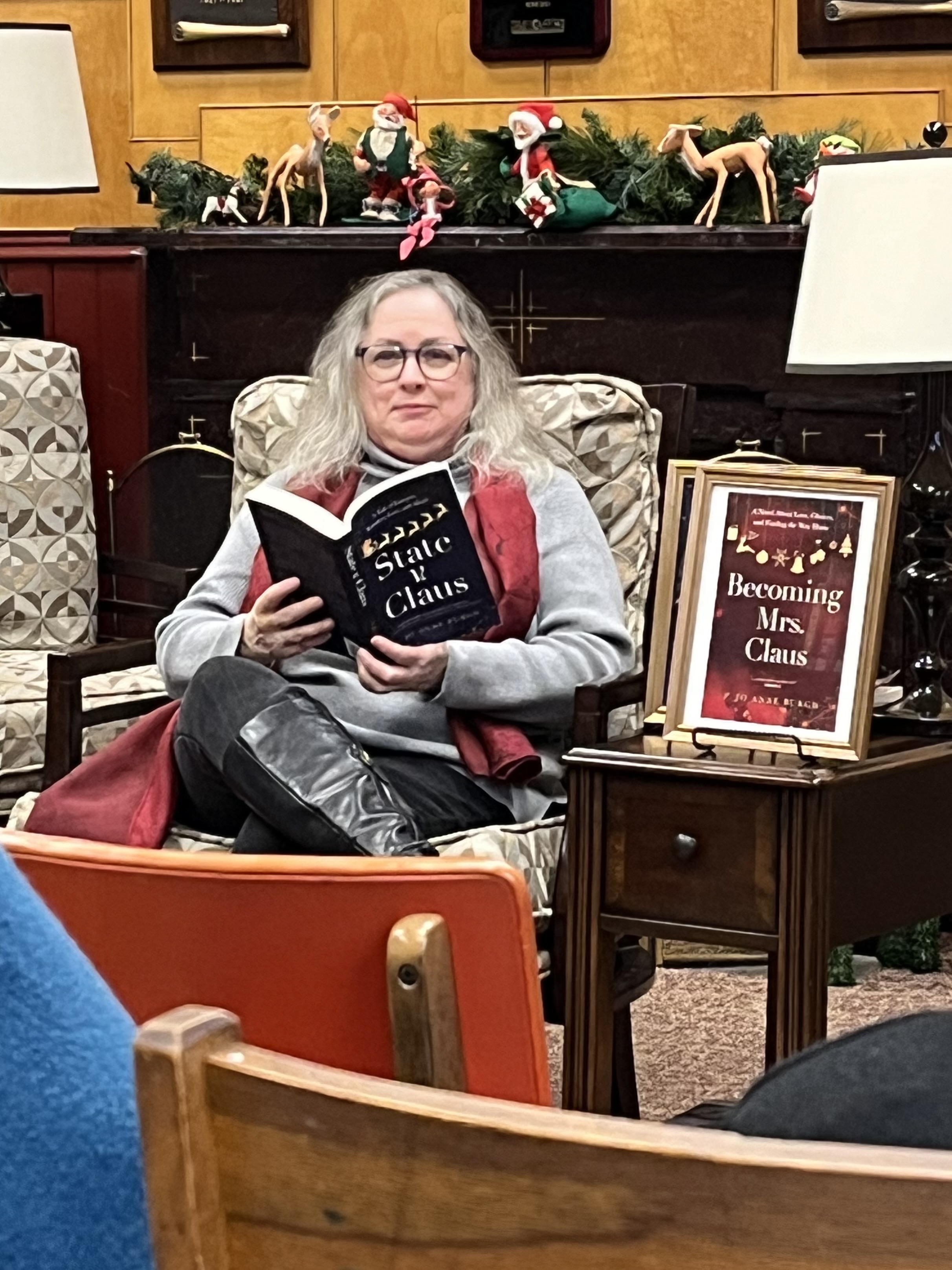
Reading at Raymond Library, Oakdale, Connecticut—November, 2023
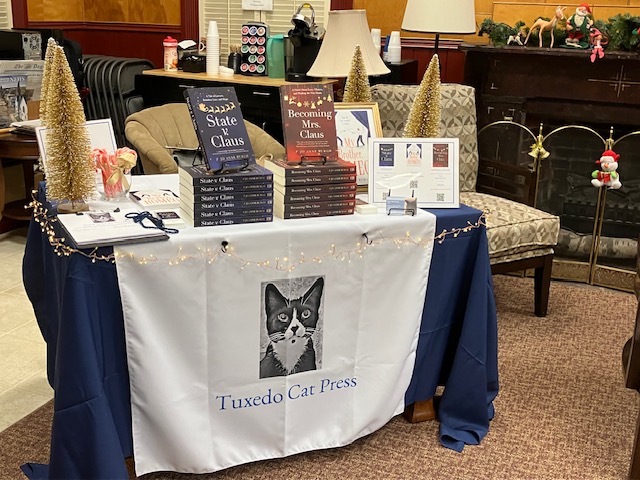
Even though October has several days left, the Season is officially under way. Opportunities to join events where I can sell books, whether exclusively for authors or with broader appeal, are coming thick and fast. On Tuxedo Cat Press’s website, the upcoming events page is being updated at least once a week.
This is now my third holiday bookselling season, and so I’d like to share with you a few more things I’ve learned—and continue to learn—about managing some specific aspects of the Season:











 P. Jo Anne Burgh