It’s Christmas Eve. All the ordering (and returning and re-ordering) is finished. All the errands—purchasing gifts and cards and wrapping paper and gift bags, all the packing and mailing of gift boxes, all the shopping for holiday meals and parties and events—it’s all done. At least, it’s as done as it’s going to be, because all the stores have closed for Christmas.
Which means that it’s time for a respite. That respite is Jolabokaflod.
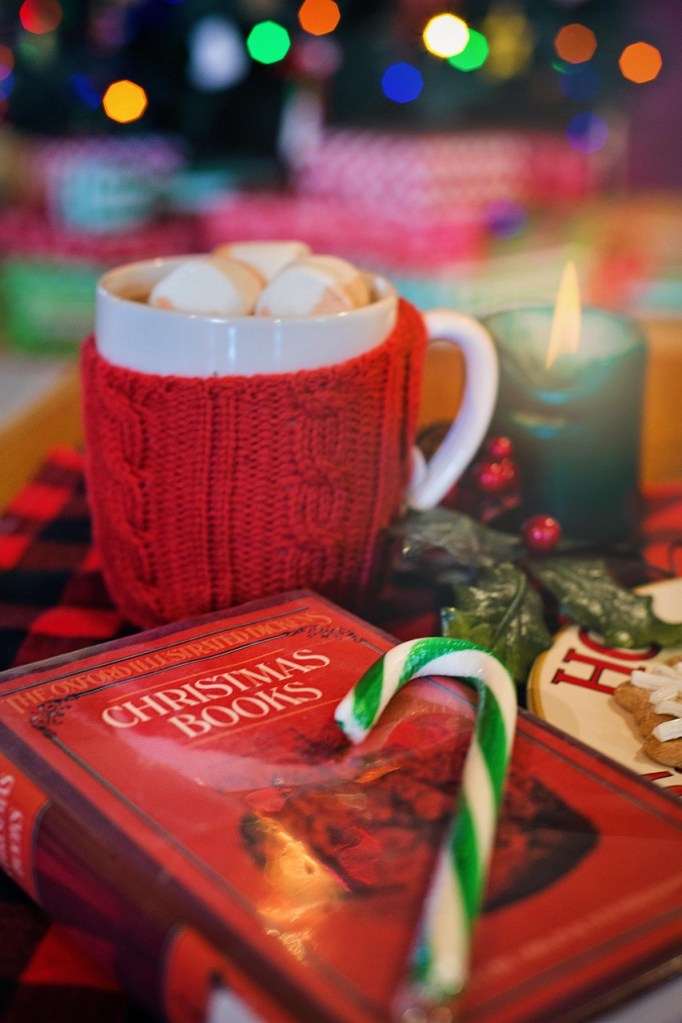
Originating in Iceland, Jolabokaflod translates approximately as “Christmas book flood” or “Yule book flood.” It’s a cozy holiday tradition celebrated on Christmas Eve. For Jolabokaflod, everyone exchanges books as gifts. Then, they spend the evening snuggled up with their new books and hot chocolate or other festive drinks, savoring the peace of the evening and the company of loved ones as they immerse themselves in stories.
Come on, admit it. You figured I threw in the towel, especially since my last blog post had nothing to do with this project.
Well, maybe. I mean, it’s been a while.
I’ll admit, I’ve missed two days (which is why this was Day 52, not Day 54). And some of my writing days have been fairly minimal—half an hour (or less), or just research, or mainly reading and editing. It’s certainly been no #1000wordsofsummer this year.
But that’s actually a good thing.
Sure, right.
No, really, I’m not making excuses. For where this book is now, a daily word goal would have been counterproductive. Word goals are good when you’re putting down the first draft and figuring out the story. That’s not where I am now. At this point, I’m fleshing out a piece of the story that I’d found wildly intimidating. By going slowly and including research, I’m making real progress, not just slap down some words and call it done progress. I’m cutting phrases and lines and paragraphs and whatever else needs to go. I’m editing what was already there to accommodate the new material. I’m seeing how the new stuff is going to impact what came before, such as where I need to drop in references so that what happens in the climactic section isn’t coming out of the blue. (I hate it when I get broadsided by critical information just at the pivotal moment. It’s like reading a murder mystery and being told on page 332 of a 335-page book that the main suspect had a twin brother nobody knew about, and the two planned the murder together, with one of them accepting an award at a black-tie event—perfect alibi—while the other committed the murder.)
The reality is that barring a flat-out miracle—including three months when I don’t have to practice law and yet money magically appears in the bank every month, as well as a brilliant (and affordable) editor who is free to drop everything and spend four weeks helping me turn this mess into a masterpiece—there is simply no way this book will be out for the holidays this year. I hate that so much. At book events last year, I kept telling people that the new book would be out this year. Now, I’m making myself a liar. The only option would be to write and publish a novella-length piece in this series, except that there isn’t time to do that because I’d have to start from scratch and it’s already the middle of June and I have no ideas for something short and self-contained. I can’t even use the first section of the present book, because there’s nothing particularly Christmasy about it, and if I’m going to publish a novella about Santa Claus at the holidays, it needs to be Christmasy. Plus, because I’m me and I require everything to fit together, it would somehow need to advance the series.
Sigh.
You’re probably wishing right now that this was another post about ecclesiastical garments. Mea maxima culpa.
Except . . . you know. . . .
No. Absolutely not. It wouldn’t work.
Well, maybe. . . .
Forget it. I’m sticking with the manuscript in progress.
But what if. . . ?
This is ridiculous. I can’t get distracted. Not now. I cannot go from start to finish on another book–especially not in time for the holidays. It is not possible. It doesn’t matter that there’s this one large, gaping hole in the narrative, and there isn’t room in this book to deal with that issue because it would make the book much longer and it doesn’t fit anywhere with any of the rest of the story anyway, so it would have to be separate anyway except that it wouldn’t be long enough to be a novel by itself, so. . . .
I’m just saying. . . .
Oh, shut up.
Photo credit: fr0ggy5 on Unsplash
Well. I certainly didn’t see this coming when I started this post. And I don’t know whether it’ll be possible anyway.
But it would address that gaping hole, which is nice because the book I’m currently working on is the final book of the series, so this would take care of that issue before I get to the finale. Not that anybody has ever mentioned the hole. Maybe I’m the only one who sees it. Maybe it’s not really a hole at all.
I hate moving away from the book in progress now, just when I’m finally getting a firm handle on it. After all, do I really have to have a new book this year? Of course not. Nobody’s going to cry if I tell them it’s not happening this year. Most of the people from last year’s events probably won’t remember anyway. It’s not as if they’re sitting around saying, “Oh, I can’t wait for [fill in the event], because P. Jo Anne Burgh said she’s going to have a new book this year!”
Sooner or later, every author hears the question: “What is your book about?” Usually, this is the point where we launch into our elevator pitch. (For those of you who aren’t familiar with the term, an elevator pitch is a very short sales pitch for your book, so named because you should be able to rattle it off in the time it takes the elevator to get to the other person’s floor.)
But when you’re working on the book, this question isn’t about sales. Rather, it’s closer to, “What is the theme of your book?” Or not even the theme, but just the general topic. For example, before I’d honed my elevator pitch for State v. Claus, I used to tell people the book was about belief. Needless to say, this vague answer didn’t sell a lot of books, but for me, it was the light shining from the lighthouse as I struggled to craft the story. What do people believe? Why do they believe? Is belief a choice, or is it just what happens? What would you believe if it might cost you everything?
For Becoming Mrs. Claus, the theme was choices. Good choices, bad choices, downright stupid choices. Making choices, or trying not to. Dealing with the fallout from poor choices. Again, a general recognition of this helped me to navigate as I plotted the story. I’m not saying it governed every decision, but the idea hung out in the background as the characters went about their days.
With my as-yet-unnamed novel (working title: Claus 3), I wrote for a long time without knowing the theme. I knew what was happening, and I had the foggiest idea how the bits hung together, but I didn’t know why I was writing about these things. To be fair, certain questions had come up while I was writing Becoming Mrs. Claus, but I ended up deleting that material because it didn’t tie well into the central theme. Plus, it would have made the book at least 30,000 words longer, and that’s a really big detour to toss in. So when I was casting about for an idea for my next book after Becoming Mrs. Claus, it occurred to me to revisit some of the material I’d excised from that book. After all, it would be so much easier to write the next book if I already had lots of material, right? All I’d have to do was to fill in a few gaps, and voilà! Instant novel! Sort of like adding water to a cup of ramen noodles and having lunch.
It sounded good, anyway.
Photo credit: Piotr Miazga
Instead, I wrote without knowing how the various pieces hung together. I did my 100K-word challenge last year, convinced that the story would fall into place and all my questions would answer themselves. It’s amazing how naïve a person can still be about process when she’s working on her third novel. But even with more than 100K words in the bank, I still didn’t know exactly what the story was about, not really. When you think about it, that’s sort of remarkable.
So I did the reasonable thing, which was to let the manuscript sit. Not a day went by that I wasn’t kicking ideas around in my head, but I seldom opened my computer. I made notes in my purple notebook, but few of them moved into the document. Then, fall came, and with it the Season of Selling. My focus shifted from creating to marketing, including hauling bins and tables to holiday markets every week. It didn’t help that Thanksgiving was late and the holiday season was short: starting with the Saturday after Thanksgiving, I had four events in eight days. The next weekend, I was supposed to have two more, but I succumbed to a nasty bronchial virus that laid me out flat and required me to cancel the remainder of the season.
As I coughed my brains out, it occurred to me that I’d been telling people for weeks that Claus 3 would be out for the holidays in 2025, and yet I still didn’t have a full first draft. This was troublesome, to say the least. On the upside, I had identified one massive problem with second part of the manuscript. So I began to rewrite that second part. I changed the setting, eliminated unnecessary characters, and tightened the plot. While it still needs editing, remedying that problem went a long way toward a completed draft for two reasons. The first, of course, was that I fixed a huge plot problem. But the second was even better: I figured out what the book is about.
Turns out, Claus 3 is about family.
And that’s where you, as my blog readers, come in.
Family is an enormously complicated topic. We think we know what a family looks like, but it turns out that “family” is a slippery little sucker that defies definition. For example, this evening when I had dinner with my mother, who is ninety and conservative, I asked her what a family looks like to her. She thought for a second before saying, “A man and a woman and two children.”
Thing is, she and Dad had three children, my two sisters and me. Plus, she was the youngest of four children born to my grandparents, in whose house also lived Aunt Florence, who never married, and her brother, George, whom she cared for because he was developmentally disabled. By Mom’s definition, neither our immediate family nor her family of origin were families.
So I pressed on, and she broadened her definition to include someone who always stands up for you, whom you can count on, who will be there for you, who will go to the hospital with you. (Two weeks ago, I took her to the emergency room after a fall, so this was apparently on her mind.) I asked if she thought my nephew and his significant other were a family; they’ve been together for eight years and are, by their own description, “as committed as you can be without involving God or the state.” She considered this, deciding that “I guess they think they are,” which presented another wrinkle: who decides whether a particular group is a family? Is it up to the individuals involved, or can someone outside that group proclaim that they are or are not a family?
Some families are created by legally recognized actions, such as marriage or adoption, while others must continually fight to be recognized as families. Ten years ago, the city of Hartford found itself faced with this question in the case involving the group known as the “Scarborough 11.” This group, consisting eight adults and three children, sought to buy a large home together on Scarborough Street, a prestigious neighborhood of single-family homes in Hartford’s West End. Some of the neighbors objected on the grounds that this group was not, could not be, a family, and the city brought suit to require them to vacate the property, while the group insisted that they were an “intentional family” and entitled to remain. Ultimately, the city abandoned its lawsuit; however, the question of whether the Scarborough 11 were a family (there are now only ten of them, one adult having departed the group) has not, to my knowledge, been resolved. (Whether a new attack is brought in reliance on the current political climate remains to be seen.)
In the introduction to her book of essays, More Home Cooking, the late great Laurie Colwin talked about blood relatives and “family by choice” as she discussed the idea of a family meal. Elsewhere, I’ve heard the term “family by chance” to describe those to whom we are linked by genetics rather than by an affirmative decision on someone’s part. Interestingly, marriages are, by definition, the creation of a family by choice. Two people who have no legal relationship choose to create a legal bond. Of course, there are those who argue that the couple alone cannot be a family; to them, there is no “family” until at least one child joins the mix. But is this a valid proposition? Are two married people a family? Are people still family after a divorce, or does that sever the family bond? What if they have a child together, but they go on to marry or commit to other people—is the entire group a family?
In Grey’s Anatomy, two of the characters, Meredith and Cristina, become very close friends. In the first season, Cristina is pregnant and plans to terminate the pregnancy. She tells Meredith that she put her down as her emergency contact person. In a line which has become resonant, she says, “I put you down. . . . You’re my person.” Neither woman is sentimental, but “you’re my person” becomes another way of saying, “You’re my family.” One article described it this way: “It’s someone who understands what you’re thinking or feeling, no explanation required.”
And then we have the blended families, which many of us recall from the days of The Brady Bunch, when Mike Brady, who had three sons, married Carol, who had three daughters. In an early episode, the youngest son struggled with the notion of Carol as a stepmother. Toward the end, I recall Carol pointing to the staircase and saying, “The only steps in this house are those,” meaning that they were all family. At the time, it seemed quite tidy; now, I wonder what those kids were supposed to think about their late parents, as well as any relatives they might have had through that parent. Were the parents of the girls’ late father no longer their grandparents? Was the brother of the boys’ late mother no longer their uncle?
All of this is designed to give you some food for thought on the issue, because I’m asking for a favor: if you’re willing, I’d like for you to tell me in the comments what you think the attributes of a family are. What are the essentials? Must there be a legal connection, such as a marriage or an adoption? Must the connection be intended to be permanent, or would a foster relationship qualify? Must there be a sexual component as between (at least) two of the adult members, or can people form a family who do not have a sexual relationship?
To be clear: I’m not interested in a political discussion. I simply want input from people about how they, as individuals, view the concept of family.
You don’t have to write a treatise; one or two lines are fine. Since this is a public forum, it’s probably still best if you use pseudonyms or initials if you want to refer to real people who aren’t public figures. (Changing identifying details would also be an excellent idea.) Also, please indicate whether it’s okay with you if I thank you by name in the acknowledgement section of this book.
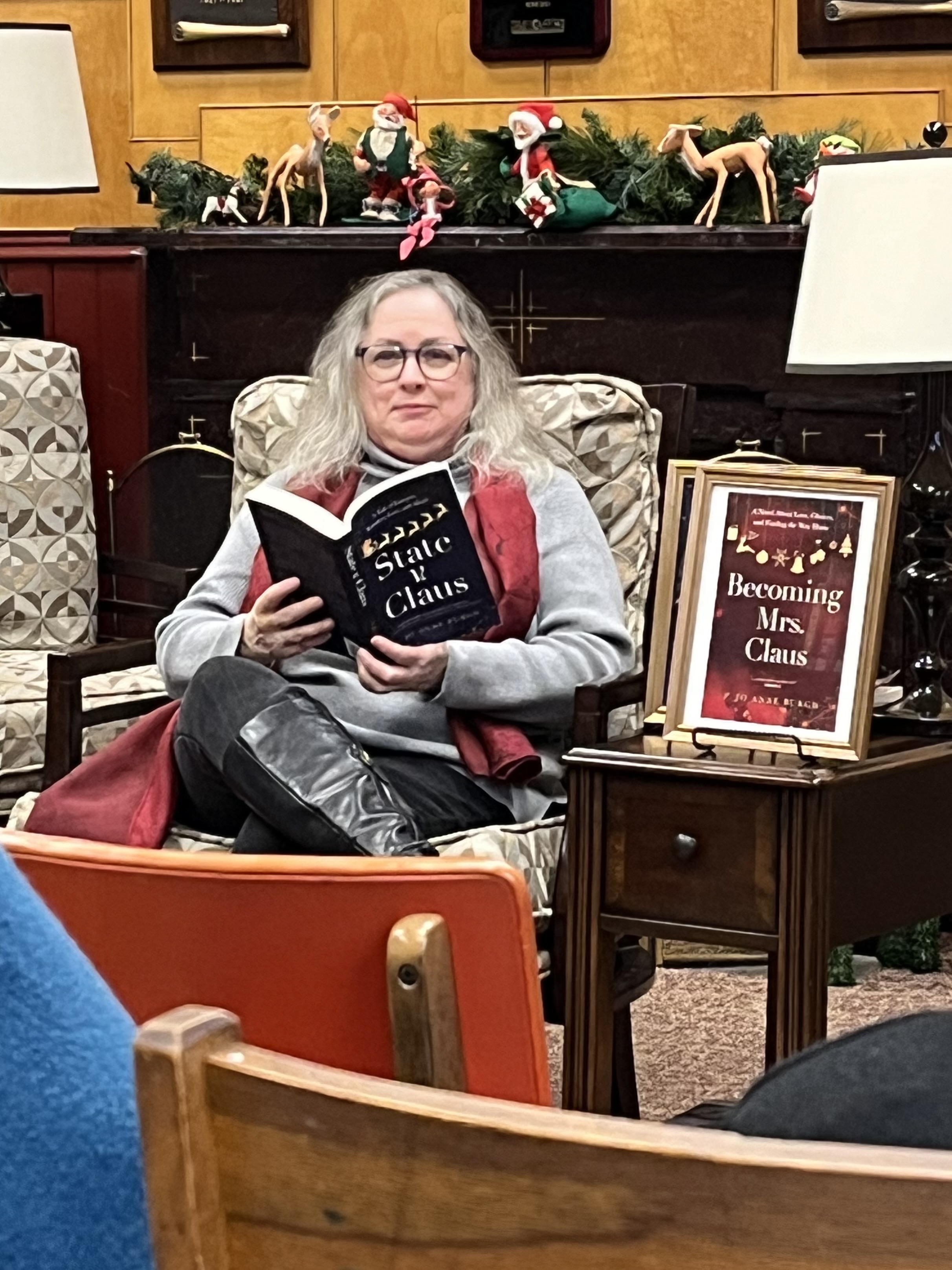
Reading at Raymond Library, Oakdale, Connecticut—November, 2023
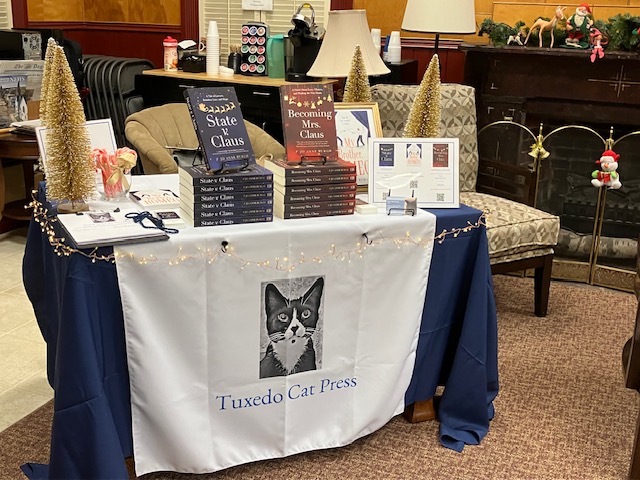
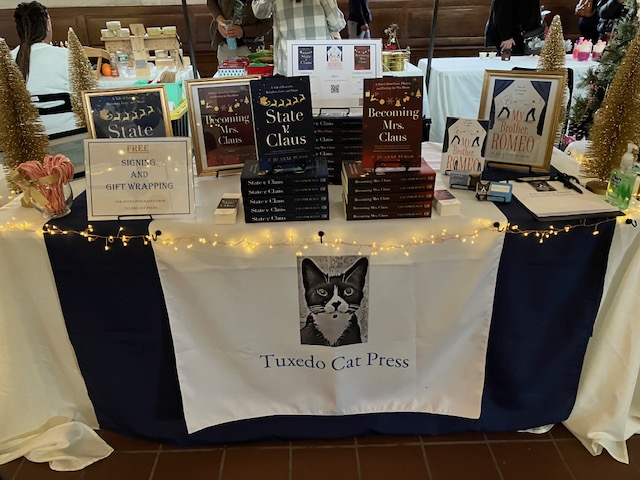
Even though October has several days left, the Season is officially under way. Opportunities to join events where I can sell books, whether exclusively for authors or with broader appeal, are coming thick and fast. On Tuxedo Cat Press’s website, the upcoming events page is being updated at least once a week.
This is now my third holiday bookselling season, and so I’d like to share with you a few more things I’ve learned—and continue to learn—about managing some specific aspects of the Season:
Last weekend, Tuxedo Cat Press had a tent at the South Windsor Apple Fest. I had no idea how popular the event would be, but I hadn’t done an event in two months, so when another author had to bow out and offered me her spot, I signed up. I figured I’d hang around, talk to some people, and maybe sell a couple of books.
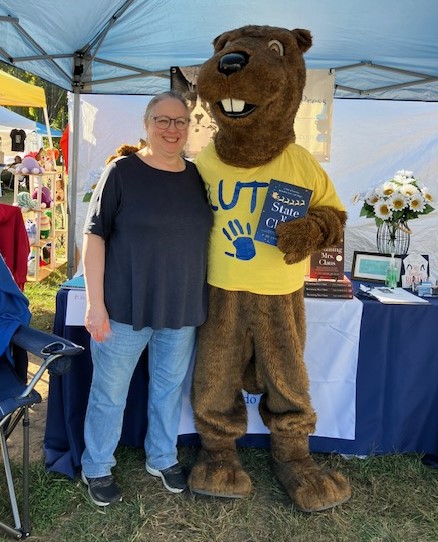
It was a long day, to be sure. I arrived at 7:15 a.m. to set up, and I didn’t get home until nearly 7:00 p.m. But it was a good, fun, and productive day, complete with perfect New England autumn weather and a visit from Chuckles, the official mascot of the Lutz Children’s Museum (and my neighbor). Best of all, sales were excellent, which always makes for a good event.
In two weeks, the Season begins in earnest. This weekend and next are my last unbooked ones until after Christmas. I recently confessed to someone that one of the main reasons I keep my Upcoming Events page on Tuxedo Cat Press’s website up to date is that otherwise, I’m likely to forget where I’m supposed to be, much less when.
Some authors don’t like to do fairs, holiday markets, and other types of events that aren’t “literary.” It’s all a matter of what you like, I suppose. That, and whatever works.
My copy of Jami Attenberg’s wonderfully encouraging book
I know what you’re thinking: “1,000 words of spring? Day 7? Did I miss something?”
No worries. It’s not you. It’s me.
First of all, the marvelous Jami Attenberg, who oversees the annual #1000wordsofsummer challenges, hasn’t actually established 1,000 Words of Spring, at least as far as I know. That’s just me on my own, using her incredible work as inspiration to write more.
I should probably start by noting that I don’t believe in writer’s block. I absolutely believe that there may be reasons that a writer doesn’t write, and some of them may be quite valid (as opposed to, say, making up crap to cover the fact that they’re just lazy). After a devastating experience in a writers workshop during my junior year in college, I didn’t write fiction for twenty-five years, apart from a couple of tiny efforts that I quickly abandoned. In my case, it wasn’t a block–it was pure fear, and I knew it. The fear didn’t begin to melt until someone whose writing I admired offered genuine and enthusiastic praise for a story I’d written. Turned out that just as some arrogant, ignorant students could shut me down with their withering comments, someone I respected could lead me back out into the sunshine.
This is not to say that I have a constant flow of confidence and I always find writing easy. I can still get jammed up, unable to come up with anything worth the effort of tapping keys. Like most writers, I have a hard drive full of false starts and outtakes, pieces that seemed to have promise until I grabbed them out of the air, crushed them in my hand, and smashed them onto the page. I expect that many writers have had similar experiences. A story is never so beautiful or perfect as the moment before we begin to put words to it.
Some people say that if you’re stuck—the words won’t come, the idea bank is empty, echoes reverberate in your brain—the answer is to fight through it. Butt in chair, hands on keyboard, and don’t get up until you’ve written. The fact that what you write may be utter dreck is beside the point. Especially if you’re a professional, waiting for inspiration is a luxury. Write the damned story, even if it sucks. You can’t edit a blank page.
The beginning of the year is a time for starting over. We sweep away old habits, old messes, old goals we didn’t meet, and in their place, we impose new ones. This year, we tell ourselves, this year will be different. This year, we’ll exercise, eat better, work harder, have more self-control. We’ll set goals and then achieve them, whether they’re little goals like losing ten pounds or big ones like selling that book we’ve slaved over for years for a six-figure advance. Of course, the internet is replete with cautionary advice about not trying to do too much, but what does the internet know about dreams?
I published Becoming Mrs. Claus last fall. Those who were reading this blog last winter know that at that point, I never thought it would happen. I was ready to trash that book and work on something, anything else.
When my sister was in fourth grade, her teacher assigned the class to interview someone with a list of questions she had prepared. Julie chose my father. One of the questions was, “What do you dislike?” Dad’s answer was prompt and memorable: “Waiting and lumpy gravy.”
I don’t recall ever encountering lumpy gravy, but I do have substantial experience with waiting. Suffice to say, I am my father’s daughter on this issue.
Sometimes, though, the wait time isn’t nearly long enough. Take the holiday season, for example. Traditionally, everything was crammed in to the roughly four-week period between Thanksgiving and Christmas. This year, though, I noticed that Christmas preparations seemed to begin as soon as the last trick-or-treaters trooped down the driveway with their bags of candy. My neighbors had had a pair of 12-foot tall skeletons in front of their house since mid-September; within a week of Halloween, the skeletons had been replaced by a giant inflatable snowman and a Santa statue. (The snowman deflates approximately every other day, but they’re vigilant about reinflating it.) It’s as though people decided that they want more time to get ready for the holidays so they don’t have to fret about delayed packages and sandwiching holiday obligations between regular ones.
As of this writing, I’ve read Amy Tan’s essay, “Angst and the Second Book,” at least twenty times. I’ve referred people to it. I’ve quoted it. I’ve underscored passages (and I’m not casual when it comes to writing in books).
Right now, this essay resonates in my soul.
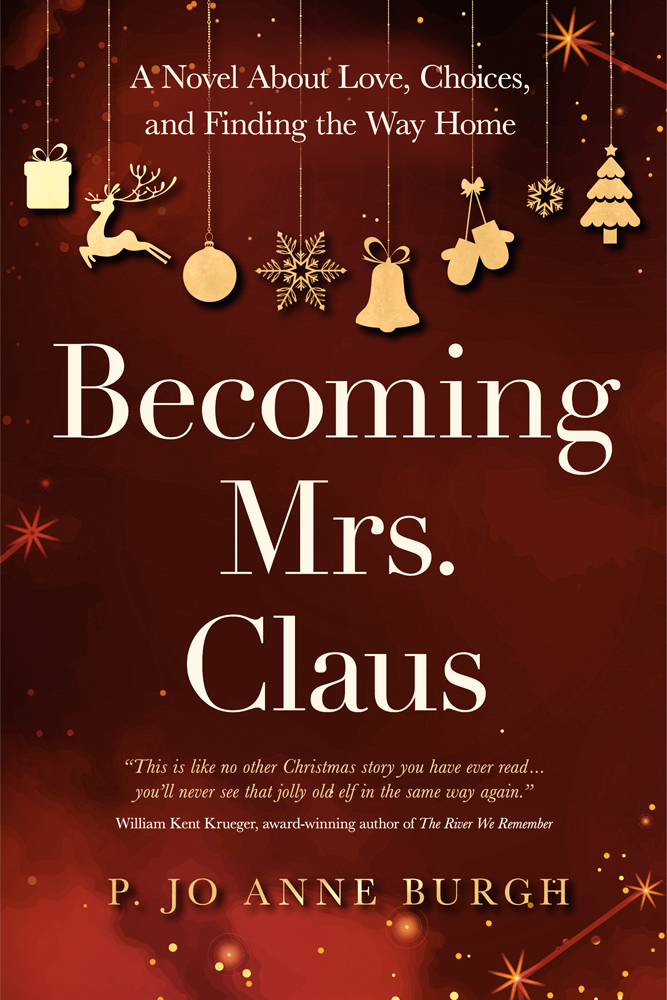
Because on November 15, 2023–less than two months from today–I shall release my Second Book.
Technically, it’s my third book. My second book was a novella entitled, My Brother, Romeo (Tuxedo Cat Press, 2021), which was issued only as an ebook. That release was a deliberate choice. I’d published my debut novel, State v. Claus (Tuxedo Cat Press, 2020), a year earlier. I wanted to build up my backlist, and I knew the sequel to State v. Claus wouldn’t be ready for a 2021 release since, among other things, I hadn’t yet written it. So I published My Brother, Romeo to fill the gap.
My upcoming book, Becoming Mrs. Claus, is my second novel. Like State v. Claus, it will be published in paperback as well as ebook. In my heart, it’s my Second Book.











 P. Jo Anne Burgh