One Hundred Days of Writing

agenda-1928416_1280

I first heard about the 100-day project on September 1, when violinist Hilary Hahn posted that she had practiced the violin for 100 days straight.

Apparently, there are all sorts of 100-day projects and challenges for everything from developing your creative side to reaching personal goals. The true purpose of many of these challenges seems to be building good habits (such as “Floss every day for 100 straight days.”).

Continue reading

Jennie

2008_1022kitten0230 (2)

Jennie Baldrin Burgh

September 14, 1987-May 26, 2009

She was special.


Resources for Writers, Part 1

IMG_1596 (3)

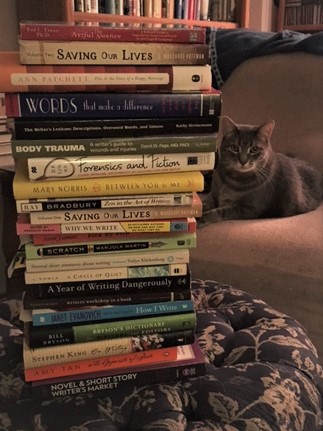
Whenever I talk with someone who’s venturing into the weird and wonderful world of writing, I inevitably get this question: “Do you know of any books that would be good for me?” As a matter of fact, I do. The bookcase in my front hall houses dozens of such volumes. Some are essays about writing and creativity; some are about the writing life (such as Annie Dillard’s The Writing Life); some focus on craft; some are resources on specific topics I’ve written about or intend to (Deborah Blum’s The Poisoner’s Handbook is a gem for those writing about murder); some contain writing prompts or odd facts designed to stir up the muse (The Book of Useless Information, by Noel Botham and The Useless Information Society). Continue reading

Perspective

IMG_2894

To say this morning did not start well is an understatement. Two days after the promised response time on a submission, I received an email informing me the story had been rejected.

But this wasn’t just any rejection. First, it was a group email, with everyone’s addresses showing. (Don’t even get me started about that. Words like tacky and insensitive come to mind.) Second, this rejection came from the same people who published my award-winning story last year. It seemed like a guaranteed acceptance. Instead, this was the literary equivalent of a high school senior not getting into her safety school. Continue reading

Writing to Cope

writing through the storm

Back then, when it was all happening, I didn’t know about Barbara Abercrombie’s book, Writing Out the Storm. But somehow, that’s what I did. It was the summer of 2007, the storm was cancer, and I wrote through it.

Rewind to May, 2006. A dear friend—we’ll call her Sarah—called me at 10:00 on a Saturday morning and upended my world with the news that had already upended hers: she had ovarian cancer. Stage 3. Metastatic. She’d found out the day before. She knew ten o’clock was early for me, but she didn’t want me hearing it from anyone else.

Continue reading

Critical Condition

archery-and-target

Maybe it’s my imagination, but it seems as though the acknowledgements section of practically every book I pick up includes a shout-out to the writer’s critique group. My primary reaction is nearly always envy: how did the writer find a group of people who were willing and able to provide useful criticism of her manuscript?

My experience with critique groups is mixed. In college, I was required to take Writers Workshop. The experience was so harrowing that I stopped writing for twenty-five years. Continue reading

The Magic of the Hour

clock

“I don’t have time to write!”

If I were to conduct a scientific survey of the reasons people who say they want to be writers don’t write, I’ll bet that this would be #1. There are plenty of others—family and work would likely rank as #2 and 3–but as often as not, I imagine those would be tied into #1.

It doesn’t help that books and articles routinely bombard the poor time-deprived writer with advice that seems impossible to follow. In predictable, frustrating, and often sanctimonious fashion, nearly all of them proclaim the same thing: Writers write. If you want to be a writer, you must find or make the time to write. Continue reading

Staying Awake

“Being centered to write is accepting the mess, loving the mess, celebrating the mess, and writing about the mess.”

~~Dacia R. Ball

*********

A few weeks ago, I posted about solitude. As one who lives alone, my perspective was obviously limited. Today, poet Dacia R. Ball offers insights about balancing the call of the creative life with the demands of motherhood. Welcome, Dacia!

Dacia Miller Ball

STAYING AWAKE

by Dacia R. Ball

I was a floundering mother with fears and self-doubt who carried within me an ardent need to understand life in all its intricacies. This was a blessing and a curse. I saw the other side, the transcendent parts of living not visible to plain sight, but I was contained within the physical demands of feedings, dirty linens, and a body fighting postpartum depression.

Through the encouragement of a community of fellow writers, I was able to return to a craft I began in my twenties and had set aside while becoming a mother in my thirties. Poetry and essays became an outlet for my musings. My sporadic blog posts ranged from theological rants to accounts of spontaneous road trips. Continue reading

Creativity on display


For everyone (like me) who’s ever wondered how composers create pieces with all those different parts, here’s your chance to watch it happen. In this video, the Artistic Advisor for the National Symphony Orchestra, Ben Folds, composes a song – including orchestration – before a live audience in ten minutes. Enjoy and marvel!

Credit: Kennedy Center (Facebook page)

Lessons from Judging a Writing Contest


gavel

Judging others is tricky business. Being viewed as judgmental is nearly always negative. Criticizing someone’s art or craft—even when that’s what you’re paid to do—can lead to some spicy battles. In the Sermon on the Mount, Jesus warns us, “Do not judge, or you too will be judged. For in the same way you judge others, you will be judged, and with the measure you use, it will be measured to you.” (Matt. 7:1-2 NIV)

Which are some of the reasons I was a bit nervous when I agreed to serve as a judge in a short story contest (which we’ll call “The Contest”).

06191703

I’ve been submitting stories to contests and publications for nearly four years. While I have had some small successes, the rejections far outnumber the acceptances. Continue reading